

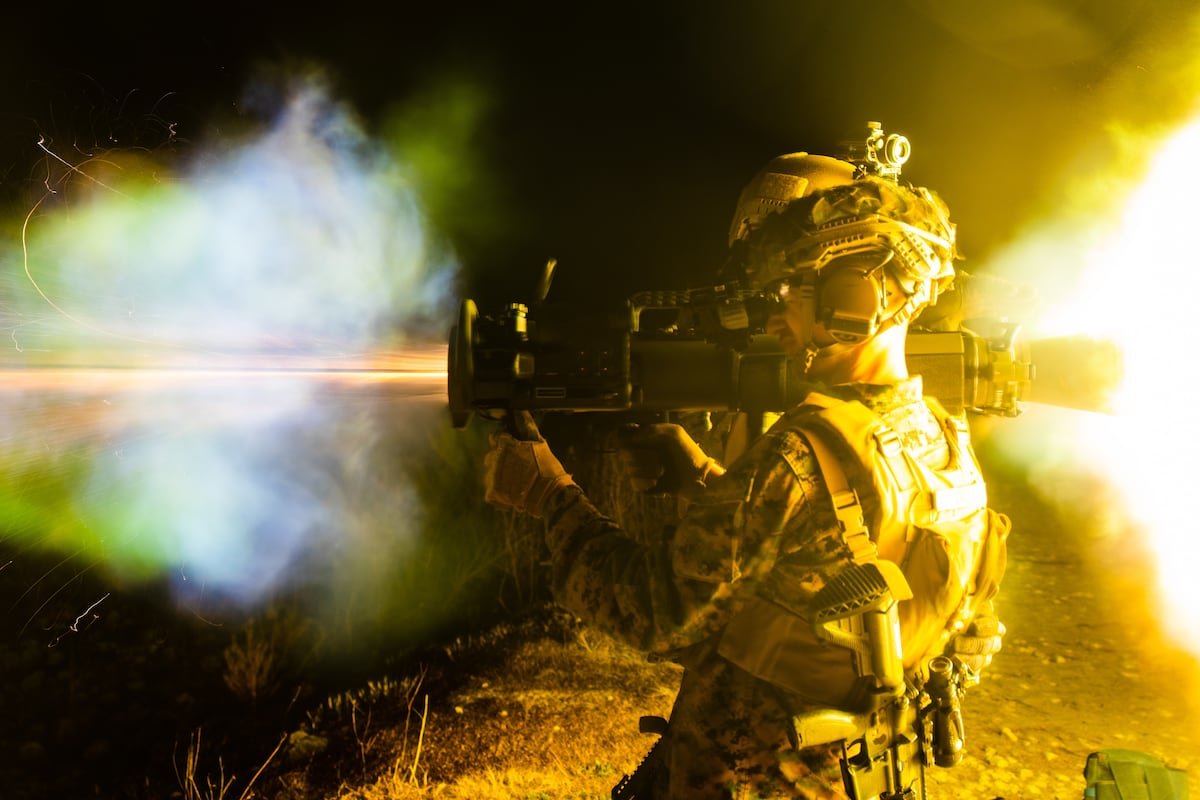
As the U.S. Marine Corps faces congressionally mandated deadlines to evaluate the brain injury impacts of weapons blasts on the force and start implementing mitigation measures, changes are already being made to limit blast exposure in training.
Brig. Gen. Sean Hoewing, head of the Corps’ newly established Risk Management Directorate, told an audience at the Modern Day Marine exposition in Washington, D.C., on Tuesday that, while the impacts of blast exposure and overpressure across time are still being studied, training supervisors have been instructed to take steps to limit prospective damage.
“If you’re an instructor on the range today, and you’re observing a Marine using a particular weapon system, we’ve already implemented distance requirements for the observer to be away from that weapon system,” Hoewing said. “Understanding that the Marine today with weapon systems that we use, many of them, they have to be in close proximity to the weapon. But anybody else that’s assisting doesn’t necessarily need to be inside that bubble where there would be danger. So those things are already being implemented.”
In February, according to Hoewing, the Corps established a baseline evaluation in a computer-based brain function assessment known as the Automated Neuropsychological Assessment Metrics, or ANAM, for all troops designated “high risk,” including weapons instructors, range staff and others whose routine work puts them in proximity to overpressure.
By this September, he said in a presentation, ANAM data would be incorporated into Marines’ periodic health assessments, an annual four-part screening administered by Navy medicine. September 2027 will see baseline ANAM evals complete for all troops.
The Marine Corps is set to evaluate a study on the impacts of blast overpressure at different levels and update the risk threshold — now set at 4 pounds per square inch (PSI) — by September 2029.
“We’re still debating amongst the scientists and medical health professionals, with the periodicity … how frequently we will do those tests from here on out, whether it’s a part of your annual periodic health assessment that most Marines will go through, or whether it’s something that’s, you know, every two years or every three years,” Hoewing said. “In the meantime, our mandate is to get after doing this assessment.”
The Corps has also built a working group, he said, to determine what to do with the information being gathered. Those tasked with building awareness may inform Marines, as well as makers of military equipment and protective gear, of blast risks and thresholds.
Those in the working group from Marine Corps Training and Education Command will have “the largest stake,” Hoewing said, as they’ll have to develop mitigation methods and procedures in a space where avoiding blast exposure altogether isn’t an option.
RELATED
“There might be policy regarding the use of [personal protective equipment] that would be within our lane,” he said. “But under the mitigation effort, there’s lots of things, whether it’s policy, range, regulations, new weapon systems and whatnot … we are one stakeholder of many in a team effort to make that happen.”
Training aids that allow Marines to build familiarity and proficiency without firing live weapons as often may also be part of the solution, according to an official with Marine Corps Systems Command who chimed in during the briefing.
“Our goal is mitigation without reducing our warfighting capability,” Hoewing said. “I wouldn’t keep anything off the table.”
Read the full article here