
In March 1915, the Great War was spreading like a plague across Europe, Asia and Africa, but the United States of America was still uninvolved and desperately striving to keep out of it.
While the menace of German submarines were becoming a growing threat in the Atlantic Ocean, nothing could be farther away from the U.S. Navy submarine F-4 (SS-23) as it performed maneuvers off Honolulu, Hawaii.
On March 25, however, the Navy was reminded that one didn’t need a war to be imperiled by the sea, as F-4 sank with Lt. Alfred L. Ede and all 20 of its crewmen.
This was the first American submarine lost at sea and the Navy aimed to raise it and find out what went wrong. But the very act of doing so put two more lives in the balance, in a peacetime drama that would eventually be judged worthy of awarding Frank Crilley the nation’s highest award for valor.
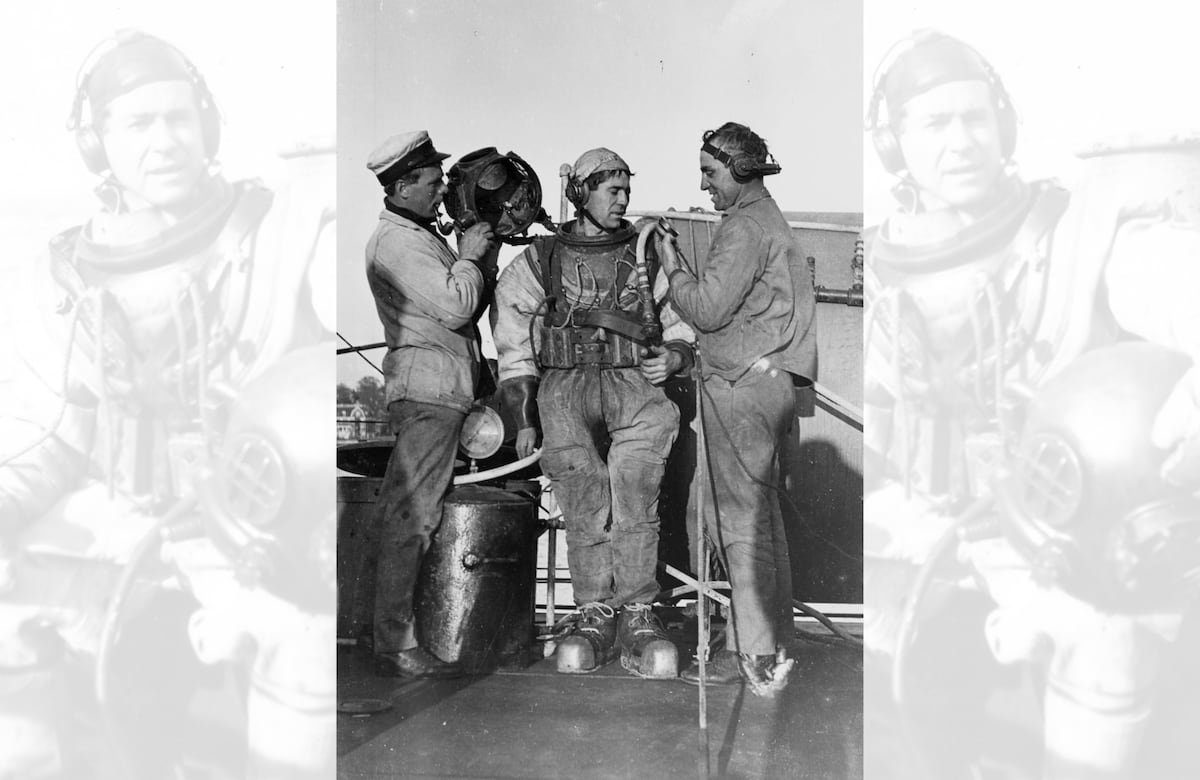
In March 1900, Crilley followed his brother into the Navy at the young age of 16 and soon focused his interest in deep sea diving. By March 1915 he had risen to Chief Gunner’s Mate in the Navy’s experimental diving team — a unit as prestigious as it was hazardous.
In mid-April, five of the divers, G.D. Stillson, Frederick Neilson, Stephen Drellinshak, William K. Loughman and Crilley, arrived at Honolulu with hard hat diving equipment, a recompression chamber and a physician, to seek the lost sub.
Making the first dive on April 16, Crilley located F-4 a mile and a half off Fort Armstrong, 304 feet below the surface — thereby setting a depth record that would stand for 25 years.
At that time the sub was upright, but Crilley determined that more cables would be needed to raise it. This would be no easy task. In order to get 20 minutes of dive time at 300 feet, about three hours were required for the descent and ascent due to the underwater pressures.
“Deep water divers need to descend slowly to allow air spaces, such as in the ears and mask, time to equalize to the pressure changes,” according to the DOD. “Slow ascents are required, too, because divers can build up nitrogen in their tissue due to breathing pressurized air. A slow return to the surface gives the body time to eliminate that nitrogen and reacclimate without risking decompression sickness.”
On April 17, Chief Gunner’s Mate William K. Loughman descended on the submersible and examined one of the wire hawsers attached to it. He then began his ascent, but at that point, things again began to go wrong. A ground swell caused the cable to jerk, fracturing his hip and causing the sub to turn over. Worse, at a depth of 275 feet his lifeline and air hose became so badly fouled by the hawser that he could neither ascend nor descend nor, for that matter, free himself.
What followed was described in Crilley’s citation:
“On account of the length of time that Loughman had already been subjected to the great danger due to the depth of water, and the uncertainly of the additional time he would have to be subjected to the pressure before he could be brought to the surface, it was imperative that steps be taken at once to clear him. Instantly recognizing the desperate case of his comrade, Crilley volunteered to go to his aid, immediately donned a diving suit and descended, after a lapse of time of two hours and 11 minutes, Crilley was brought to the surface, having by superb exhibition of skill, coolness, endurance and fortitude, untangled the snarl of lines and cleared his entangled comrade so that he was brought, still alive, to the surface.”
On Aug. 29, in a diving and engineering precedent, the Navy finally managed to raise F-4, which was found upside down. The fatal flaw turned out to be corrosion of the lead lining of the battery tank, which had let seepage of seawater into the compartment, causing the captain to lose depth control of his ship.
Although the drama off Fort Armstrong made Crilley a legend in deep diving circles, his career had just begun.
He rose to ensign in the Naval Reserve and later a chief warrant officer in the U.S. Coast Guard. With the latter, he was awarded the Silver Lifesaving Medal in April 1916. In 1917 he held command of the derrick salvage barge Salvor.
Returning to active duty, Crilley assisted in the repair or raising of a variety of ships. This included the submarine S-51, and after submarine S-4 was sunk in a collision with Coast Guard destroyer Paulding in December 1927, his role in raising it on March 17, 1928, earned him the Navy Cross.
Amid all that, on February 15, 1929, he was finally called to the White House to receive the Medal of Honor — 14 years late — from President Calvin H. Coolidge.
In 1931, Crilley served as second in command of the submarine Nautilus on its ultimately abortive 3,000-mile voyage to the North Pole, as well as salvaging the presidential yacht USS Mayflower. In 1939 he helped raise the submarine Squalus.
The pioneering naval diver died on Nov. 23, 1947 at the Brooklyn Naval Hospital. He was buried with full military honors in Arlington National Cemetery.
Read the full article here