

More than 80 years after its sinking, long-buried documents in both the American and Japanese archives held the key to locating the seemingly lost location of the Japanese “Hell ship” Hōfuku Maru. Now, explorer Josh Gates, working with the Hellships Memorial Foundation, is taking viewers along for that historic journey in an all-new season of Expedition Unknown.
The first episode of the two-hour event premieres on Wednesday, June 24, at 9 p.m. Eastern Standard Time on the Discovery Channel.
On Sept. 21, 1944, the Hōfuku Maru, alongside 10 other ships forming Convoy MATA-27, was transporting more than 1,000 Allied Dutch and British service members when it was sunk by American planes.
Among combatants on both sides, the Japanese alone refused to guarantee the safety of POWs at sea or mark their prisoner transports. Friendly fire accounted for a staggering 93% of the POW deaths on these ships, according to Gregory Michno, author of Death on the Hellships.
According to historian David Aquila, to add to the sheer terror of the experience, by 1944 these hell ships were carrying prisoners in numbers six times greater than what the Japanese had deemed acceptable at the beginning of the war. This practice, called chomansai, or super-full capacity, gave each man less than one square yard of space for voyages that lasted up to 70 days. The crowded, disease-ridden conditions, says historian Gavin Daws, were comparable to those on the slave ships of the 18th century.
One of the few survivors of the Hōfuku Maru sinking, Capt. Nigel Evans, later testified in British war crimes trials held in Singapore shortly after war’s end.
“Conditions on board became terrible,” Evans said. “It was a common sight to see prisoners of war eating their meals within six feet of a corpse being prepared for burial. On the day before we sailed, over a third of officers and men were unable to walk unassisted and there were a number of mental cases.”
Evans survived the sinking by boarding another Japanese ship and was taken to a POW camp in Taiwan.
By the end of the war, conservative estimates suggest that 50,000 Allied POWs boarded hell ships, and 21,000 of those men did not survive. That tally accounts for more deaths, according to Michno, than were sustained in combat by the U.S. Marines during the entire Pacific campaign.
The sinking of the Hōfuku Maru that September day marks one of the largest single-day losses of Allied POW lives.
Struck by an Allied torpedo, the vessel was split in half and went under the water in less than three minutes. More than 1,000 Allied POWs were still trapped in its hold. Due to incorrect U.S. records of the event, searchers were led too far north for decades.
That is until researcher John Duresky of the Hellships Memorial Foundation and historian Tim Beckensall stumbled upon a digitized Japanese after-action report written by officers on board the convoy’s lead ship. It contained a hand-drawn account detailing the location of each ship within the convoy and a note stating that the Hōfuku Maru sunk at 10:35 a.m.
But the revelations didn’t stop there. Hidden in plain sight was an aerial photograph captured by the lead American Curtiss SB2C Helldiver just moments before the attack.
“This is what they refer to in the business, guys, as a smoking gun,” says Gates.
“We were absolutely stunned that Japanese sources had information on where the convoy was attacked and what ships were hit,” says researcher Randy Anderson.
Beckensall shared his archival findings with the British Embassy, then the Dutch and Philippine military attachés.
After the compelling evidence, the Cultural Heritage Agency of the Netherlands agreed to fund an initial sonar survey and a preliminary dive mission to the site, which took place this past December and January, CNN reports.
But the dive mission initially hit a snag. Despite divers finding some kind of wreckage that pointed to the Hōfuku Maru, the 1991 eruption of Mount Pinatubo and the subsequent flood of volcanic ash threatened to engulf the wreck.
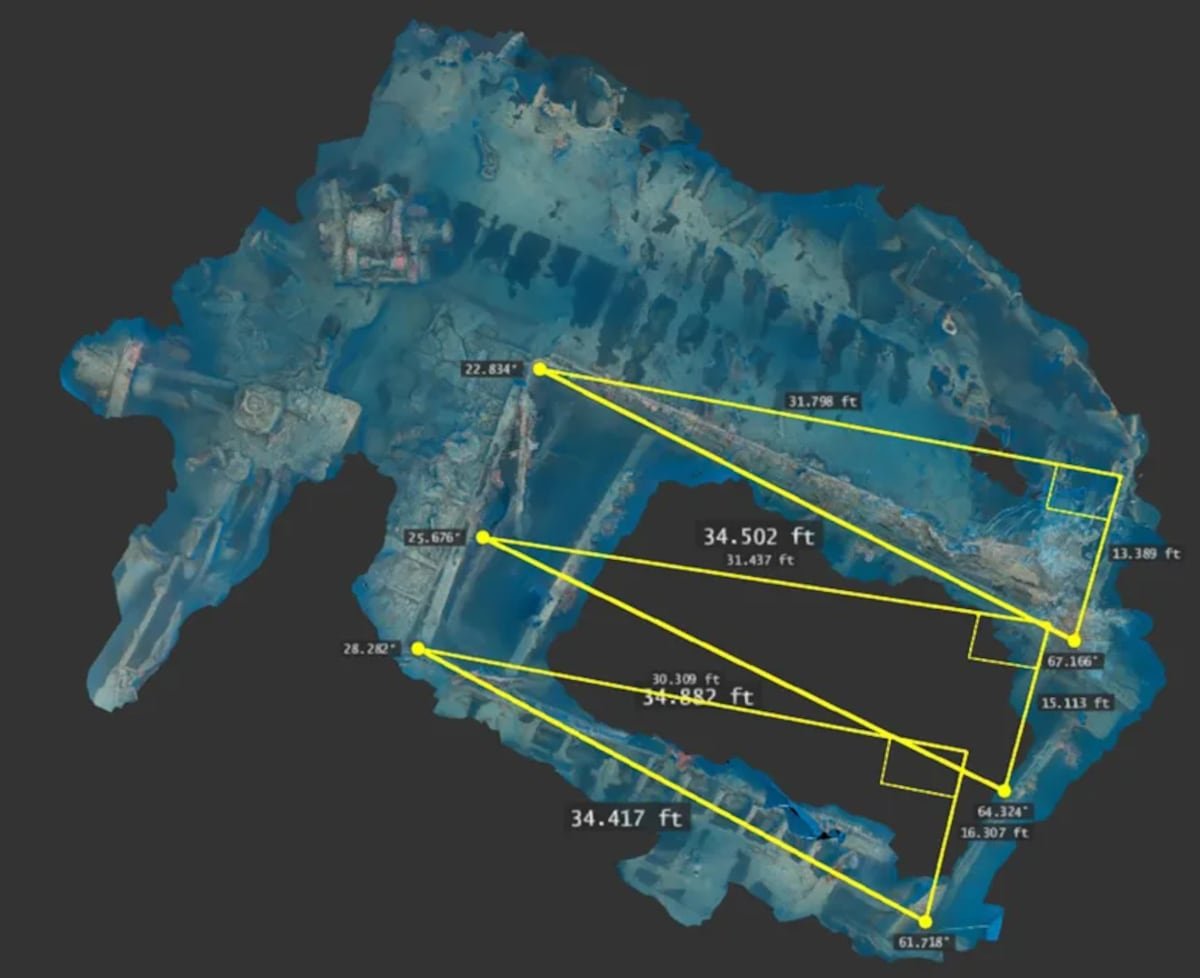
With the help of Calvin Mires, a maritime archaeologist for Marine Imaging Technologies, and Evan Kovacs, an underwater imaging specialist, hundreds of images were taken of the wreck and then turned into a 3D model via a technique known as photogrammetry.
Mires and Gates have dived the wreck several times, reporting that they encountered human remains on the deck. Neither went into the holds.
“This ship is a grave, and now that she’s been identified, the governments of the UK, the Netherlands, and the United States have been notified, and they’ll determine the next course of action,” Gates told CNN.
Using “a combination of navigation analyses and archival, cartographic, and archaeological evidence,” the Cultural Heritage Agency of the Netherlands confirmed on June 8 that the vessel is “most likely” the Hōfuku Maru.
“The pieces all fit,” states Beckensall in the release. “The vessel is the right size, in the right place and from the correct period. I am convinced this is the Hōfuku Maru.”
Claire Barrett is an editor and military history correspondent for Military Times. She is also a World War II researcher with an unparalleled affinity for Sir Winston Churchill and Michigan football.
Read the full article here