


Every prepper has heard of the “gray man” concept at some point. The idea is simple: during a major disaster, you don’t want to stand out in a crowd. You dress plainly, avoid flashy gear, and move through the world without getting noticed by people who might be looking for someone to rob, exploit, or follow home.
This same principle can apply to your home as well. In a long-term disaster or societal breakdown, your home sends out signals all day and all night, whether you mean it to or not. A well-kept lawn, solar panels on the roof, or the smell of dinner cooking can all say the same thing: “these people have something worth taking.”
A house that looks like a fortress can be just as bad because a fortress tells everyone that somewhere inside, there’s something valuable enough to protect. The goal isn’t to look strong. It’s to look like the last house you’d bother breaking into.
This idea is often called the “phantom home” strategy, and we came across a great breakdown on the YouTube channel, Reliable Prepper. You can watch the video below, but we also typed up the steps for you.
Want to save this post for later? Click Here to Pin It On Pinterest!
Step 1: Change How Your House Looks From the Street
Before anything else, walk your own neighborhood like you’re a criminal looking for an easy target. Notice what catches your eye. It’s usually things like:
- Solar panels on the roof
- A perfectly manicured lawn when everyone else’s looks rough
- Brand new security cameras
- A well-stocked garden full of fresh vegetables
- Clean, new-looking outdoor equipment
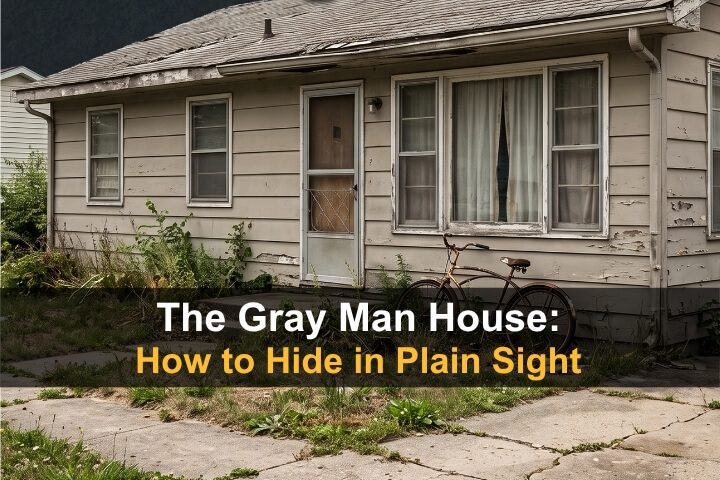
Every one of those things puts a bullseye on your home. Instead, aim to look poor and forgotten:
- Let your grass grow a little longer than usual
- Let some paint peel on the fence
- Put up a tarp or two that looks like a hasty repair
- Scatter some old cardboard or debris around the yard
The goal is to blend in with houses that look like they’ve been hit hard by tough times, not to stand out as the one family that’s doing just fine.
Step 2: Hide Your Real Security Upgrades
While the outside of your house looks rough, the inside should quietly be getting stronger. None of this should be visible from the street:
- Replace the short screws in your door frames with 4-inch screws that bite deep into the wall studs
- Add security film to your windows. It’s clear, so nobody can tell it’s there, but it makes the glass far harder to break through
- Disconnect the automatic garage door opener, since those can be cloned with cheap devices, and reinforce the door with steel bars on the inside
- Add hardware cloth (metal mesh) behind windows so that even broken glass won’t create an opening
The key is that you want people to think your house isn’t worth the risk, not that it’s simply hard to break into. A house that looks difficult to break into can actually invite more effort, not less, because criminals assume anything that well-defended must have something good inside.
Step 3: Control Your Light Signature
When the power grid is down and most houses are dark, any sign of normal life inside a home stands out immediately. Light control matters more than most people realize:
- Black out your windows completely. Curtains alone aren’t enough
- Use reflective insulation with the shiny side facing in and the dull side facing out to create a heat and light barrier
- Layer that with thick blankets or heavy fabric, and check for gaps where light could leak
- Test it yourself: have someone stand outside while you use a small flashlight inside, and see how much light escapes
A single candle can be visible from hundreds of yards away on a dark night, so even small leaks matter.
Step 4: Control Your Sound Signature
Once the ambient noise of daily life disappears (no traffic, no air conditioners, no lawnmowers) every sound your family makes will carry much further than you’re used to. To manage this:
- Train your family now to move quietly and speak in whispers during certain hours
- Turn it into a game for kids, with a small reward for going a full evening without unnecessary noise
- Add foam padding to the inside of doors
- Use carpeting or rugs to deaden footsteps
The habit of moving quietly needs to be built before a crisis hits, since trying to retrain your family’s behavior in the middle of an emergency is nearly impossible.
Step 5: Control Your Smell Signature
Cooking smells travel far, and when everyone around you is hungry, those smells can act like a dinner bell pointing straight at your front door. To reduce this risk:
- Use a pressure cooker when possible, since it seals in smells far better than open cooking
- Make sure exhaust fans are working, but think carefully about where they vent to and consider redirecting or filtering that vent
- Time your cooking for when neighbors might also be cooking, or when weather conditions will disperse smells more quickly
Step 6: Build a Silent Early Warning System
You don’t need expensive tech to know when someone is prowling around your property. Some of the simplest systems work even without power:
- Can alarms: Balance empty cans on thin pieces of metal or wood along fence lines or anywhere someone might sneak through. If they’re bumped, the cans fall and shift position, which tells you the next morning that someone was there, even if you didn’t hear it happen.
- Flour traps: Sprinkle flour or fine dirt along pathways, gates, windows, and fence lines. Check these areas each morning for footprints or disturbed areas. This system resets itself; just smooth it back out for the next night.
- Trail cameras: If you have some budget, hide trail cameras in fake rocks or disguise them as ordinary equipment to capture photos of anyone checking out your property.
- Motion lights: These can work, but they can also reveal that someone is home, so use them carefully. Sometimes it’s better to know someone is there without them knowing you know.
Step 7: Build Layered Physical Defenses
Think of your property like an onion, with each layer serving a different purpose:
- Outer layer (roughly 50 yards out): Use landscaping, strategic debris piles, or even broken-down cars to funnel people into areas where you have the advantage, rather than areas where they could surprise you.
- Yard layer: Keep clear lines of sight so you can see what’s happening, while eliminating hiding spots. Know the distances from your windows to key points in your yard, since that information matters if you ever need to use a weapon.
- House layer: This is where the hidden reinforcements come in: upgraded door frames, security film, and a reinforced garage door. All of it is designed to slow someone down and buy you time, since every extra minute is a minute closer to help arriving or to you being ready.
- Safe room / citadel: Usually an upstairs bedroom or interior room, reinforced with a solid (preferably steel) door and stocked with enough supplies to last your family at least three days: water, food that doesn’t need cooking, a way to communicate with the outside world, first aid supplies, and weapons if you’re comfortable with them.
Step 8: Set Up Hiding Spots and Escape Routes
Sometimes the best move isn’t to fight at all, it’s to disappear until the threat moves on. Inside your home, aim to have at least two or three hiding spots that wouldn’t be obvious during a quick search, such as a reinforced closet with ventilation or the space under a staircase. Stock each one with:
- Water
- Food that doesn’t need cooking
- A way to quietly communicate with the outside world
- A waste container, since you may be in there for hours
- Books or quiet activities for kids
These spots should also let you hear what’s happening in the rest of the house without being detected, since knowing whether intruders have left or are still searching can matter a great deal.
Beyond hiding, plan actual ways out of the house that don’t rely on the front door:
- Second-story windows with rope ladders you’ve practiced using
- Basement exits that lead to areas with good cover
- Crawl spaces that lead outside
Practice these routes with your family so everyone can use them in the dark or under stress, and set a predetermined meeting spot away from the house, ideally somewhere with good visibility of the home but also some cover and concealment. Make sure everyone knows more than one way to reach it in case a route gets blocked.
And remember: your house and your belongings can be replaced. Your family cannot. Stuff is just stuff, and there’s always a way to rebuild if you’re alive to do it.
Step 9: Take Care of Physical and Mental Health
Long-term stress takes a toll that’s easy to overlook when you’re focused on security. A few things to prepare for:
- Make sure at least one person in your family has taken a basic first aid class, and stock medical supplies well beyond band-aids and aspirin
- Learn how to properly clean and dress wounds and recognize signs of infection
- Know some low-tech improvisations: clean tampons can pack wounds, sanitary pads work as large bandages, and honey has natural antibiotic properties
- Maintain some kind of routine for the family, even when everything else has changed. Reading by candlelight or playing quiet games can help everyone feel more normal
- Give kids age-appropriate explanations and small jobs to do, so they feel like they’re helping instead of just being scared
Step 10: Plan for the Long Haul
Most people prepare as if an emergency will last a few days. Real societal breakdowns can stretch on for months or years, which means thinking beyond your initial stockpile:
- Food: Indoor growing and sprouting can provide fresh nutrients when a full garden isn’t practical. Sprouts can be grown from beans and seeds with nothing but water and a jar, and herbs like basil or cilantro can grow on a windowsill.
- Water: Know how to purify water from natural or questionable sources. Boiling works but uses fuel, purification tablets run out, and simple sand and charcoal filters can provide clean water indefinitely as long as you have a source.
- Power: Generators need fuel you likely can’t sustain for months, and solar panels can make your home a visible target. Consider smaller, more discreet portable solar setups, or alternatives like small wind generators or exercise bikes converted to generate electricity.
Final Thoughts
None of this needs to happen overnight. Start with the basics: make your house look less appealing to criminals, work on hidden security upgrades, and build quiet habits with your family. Even just handling light, sound, and smell control puts you ahead of most people who think preparedness starts and ends with buying gear.
The phantom home strategy isn’t about becoming a paranoid hermit or turning your house into a bunker that worries the neighbors. It’s about being smart enough that when someone sizes up your home, they decide it’s simply not worth the trouble. That’s a complete win, with zero shots fired and zero people put at risk.
Like this post? Don’t Forget to Pin It On Pinterest!

Read the full article here