
In the mid-1930s, Adolph Hitler cast his eye towards France and dreamed of revenge for the outcome of World War One. Standing in his way was the French Maginot Line, a collection of massive concrete strongpoints, casemates, armored turrets, and observation posts. Among the barbed wire, mine fields, and tank traps, there were nearly 5,000 bunkers defending France.
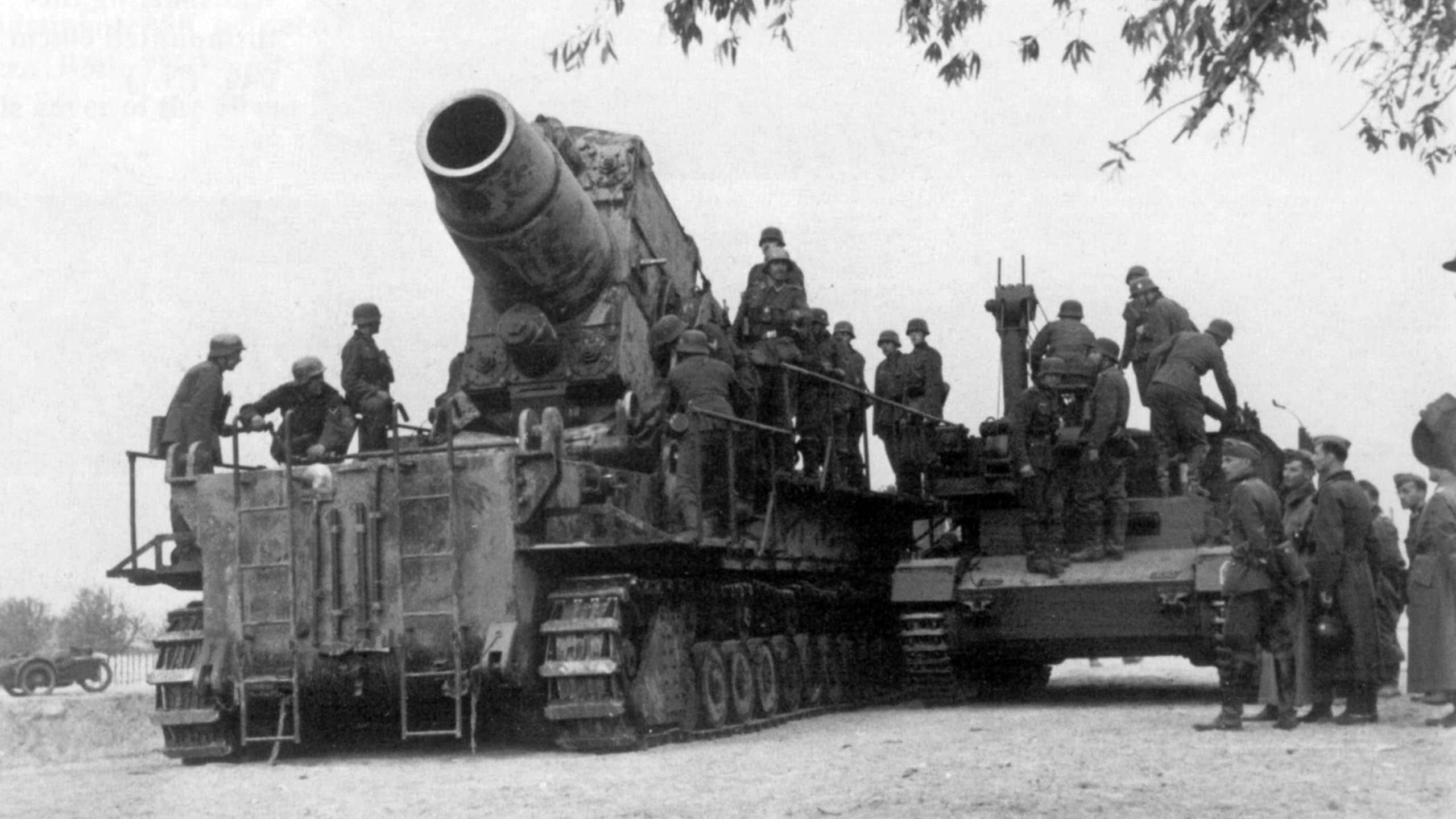
Despite this intimidating defensive line, during 1936 Rheinmetall proposed development of a super-heavy howitzer to attack the Maginot forts. The original plan was to have the mortar components carried to the battle site by several tracked carriers and then assembled in the field. The size and complexity of the mortar, coupled with the excessive assembly time extinguished this notion, and in January 1937 Rheinmetall pivoted the concept to a huge self-propelled gun (137 tons). The vehicle was to be carried as close to the attack area as possible by rail, and then the massive, tracked carriage would crawl forward at about 6 mph.

Driving trials began in 1938, under the supervision of General of Artillery Karl Becker, and after continued development the weapon took his name as the “Karl-Gerät” or “Mörser Karl”. Automotive testing continued into 1939, and test firing finally took place in the summer of that year. The Karl-Gerät was still undergoing trials in May 1940, so the giant mortar never had the opportunity to fire on the Maginot Line during the invasion of France. Work on the system continued, and six production vehicles were delivered to the Wehrmacht between November 1940 and August 1941. There was a total of seven Karl-Gerät made — 1: “Adam” (later “Baldur”), 2: “Eva” (later “Wotan”), 3: “Thor”, 4: “Odin”, 5: “Loki”, and 6: “Ziu”. The seventh vehicle was a test bed and was not named.
There were two mortar types, distinguished by their interchangeable barrels:
- Gerät 040: The original model, using a shorter (L/7) 600-millimeter (24 in) barrel
- Gerät 041: The later model, with a longer (L/11.55) 540-millimeter (21 in) barrel.
Complicated Process
While the Karl-Gerät Mortars were technically self-propelled guns, their tracked carriage could only carry them short distances. Long trips to and from the front were handled by rail, aboard a “Schnabel Car” — with the entire chassis hung between two rail cars on a pair of gigantic, swiveling crane arms. When the rail journey reached its closest point to the mortar’s firing position, the Karl-Gerät was lowered from the railcar support arms and driven (slowly) into position.

The road to the firing position had to be carefully prepared as the 137-ton vehicle could not negotiate hills or soft soil. Careful attention was paid to the firing position as well because the ground needed to be absolutely level. The Karl-Gerät could only be loaded with the barrel at “zero elevation”, and even minor variations in the ground level could throw off the entire process. Consequently, the mortar was re-laid for every shot. Rate of fire was dependent on many factors, and the complicated process was taxing on the gun crew. Two or three rounds per hour would be a good rate.

Once the mortar(s) began firing, it was difficult to disguise their location. Enemy counter-battery fire was always a danger, as was air attack. Light and heavy flak batteries were assigned for protection, but the Karl-Gerät was normally used only in areas where the Luftwaffe maintained complete air supremacy.
Attacking Soviet Forts with Karl-Gerät
Operation Barbarossa, the German invasion of the Soviet Union, provided the Karl-Gerät (040/041) mortars with their first combat opportunities. The newly formed “Heavy Artillery Battalion 833”, comprised of two batteries, each with two 60 cm mortars, was ready for action in May 1941. One battery was sent to bombard the Soviet fortress at Brest-Litovsk while the other attacked the fortifications at Lviv. The mortars fired most of their available ammunition by June 24th, and both batteries were withdrawn to the Reich for additional work on the vehicles and improvements to the ammunition.

There were several ammunition types for the 60cm (24-inch) mortar, the heaviest of these weighing nearly 4,800 pounds. Depending on the shell type, Mörser Karl’s maximum range was 6.2 miles.
Live The Armory Life. The latest content straight to your inbox plus an automatic entry to each of our monthly gun giveaways!
Each Karl-Gerät required support from two or three modified Panzer IV tanks that operated as ammunition carriers (the “Munitionsschlepper für Karl-Gerät”) — their turrets replaced by a box-like superstructure that could carry up to four 60cm shells along with a loading crane. A total of 22 Panzer IV chassis were converted for this role.
On to Sevastopol
The Soviet fortress at the port city of Sevastopol, on the southwest corner of Crimea, was a commanding presence on the Black Sea. The fortifications there resisted Axis field artillery and air attacks beginning in late October 1941, and by June of 1942, Hitler was furious that the communist bastion had not fallen.

Around the port, the Soviet Navy had enhanced their older defenses by adding a group of turret-mounted 180mm and 305mm naval guns which could defend against from the land as well as the sea. The positions were protected by massive concrete forts and armored gun turrets nearly 10-inches thick.
For the assault, the attackers assembled a massive amount of field artillery — nearly 900 guns (of up to 150mm) between the German and Romanian forces — with enough ammunition for twelve days of firing. More than 120 Nebelwerfer rocket launchers added their weight of fire. In addition, the Germans sent a pair of 280mm K5 railway guns, two 420mm and two 355mm howitzers, and four 305mm Skoda mortars to bombard the fortress.

Finally, three of the 600mm Karl-Gerät mortars joined with one 800mm Schwerer Gustav railway gun to deliver one of the most furious artillery barrages of the entire war. At the same time, the Luftwaffe flew a record number of support missions, delivering thousands of tons of bombs on Sevastopol and the surrounding area.
The three Karl-Gerät mortars of Heavy Artillery Battalion 833 focused their attention on the two armored turrets (each with two 305mm guns) of the “Maxim Gorkii” coastal defense battery. The tracked mortars were able to reach their camouflaged firing positions without damage from Soviet counter-battery fire and began firing on June 2, 1942. All available ammunition had been used by June 13th — 72 heavy and 50 light concrete-piercing shells fired in that time. Additional ammunition was brought in, and the mortars began firing again in earnest, with 50 of the light shells fired on June 30th alone, and more than 20 heavy shells fired on July 1st.

The armored Maxim Gorkii turrets proved to be difficult targets, the thick plate turning away several direct hits, and limiting the damage to a jammed turret and damage to its electrical supply. However, the concrete-piercing shells did significant damage to the turrets’ supporting structures, crew quarters, and the nearby command bunker. Sevastopol fell on July 5th, and the Karl-Gerät were withdrawn to the Reich for refitting on July 19th. Meanwhile, a three-gun battery was prepared for the proposed offensive against Leningrad in September 1942, but the Soviet’s broke Hitler’s Army Group North siege of the city was broken before the mortars reached their firing positions.
Suppressing the Warsaw Uprising
Despite their careful planning of the Warsaw uprising in August 1944, the leaders of the Polish Home Army (Armia Krajowa) did not expect to face bombardment by a 60 cm super-mortar. While gun battles raged on Warsaw’s streets, a single Karl-Gerät (#6, “Ziu”) was sent to the west side of the city to blast the Polish resistance. “Ziu” began launching 60 cm shells on August 18th, and while some of the special concrete-piercing rounds exploded with dramatic effect, several did not. A few massive duds were found (after penetrating several floors and coming to rest in a deep basement) and defused by Polish engineers, who then reportedly used the newfound explosive to make hand grenades! One of Ziu’s unexploded shells was most recently found in August 2012 during improvements to the Warsaw Metro.

By the end of September, a total of four Karl-Gerät were deployed to the Polish capitol as the Germans committed to destroy the city. By January 1945, 85% of all buildings had been destroyed. The mortars returned to Reich, most to be fitted with the later-model, longer-range 54 cm barrels (Gerät 041).
The Karl-Gerät lingered in Germany during the fall of 1944, but two of the mortars were detailed to provide fire support for the German offensive that started the Battle of the Bulge. There is no documentation of the effects of their fire during the battle, but #2 (“Eva”) was damaged by air attack and withdrawn to Jüterbog for repairs.
In mid-March, Karl-Batterie 638 was sent to attack the American bridgehead across the Rhine, and beginning on March 20th, it fired 14 rounds at the Ludendorff railway bridge and the pontoon bridge nearby. No hits were made on the bridges, with many of the shells falling into Remagen town. The mortar was quickly removed, as by this point the Allied fighter-bombers ruled the skies.

When the end came in Germany, U.S. forces captured three of the Karl mortars: numbers 2 and 5 were found in the American First Army area, while #7 (the test bed) was captured at Hillersleben. The number 7 mortar was sent to the US Army Ordnance Museum at Aberdeen Proving Grounds, but was scrapped by the early 1950s. The Soviets captured two mortars, #IV and #VI, one of which is on display at the Kubinka Tank Museum in Russia.
Karl-Gerät Reviewed
A U.S. Ordnance Technical Intelligence Report dated June 29, 1945, reviewed a pair of Karl Gerat mortars, captured in the First Army area during April. The following are excerpts from that report:
The 54cm and 60cm “Karl Gerats” recovered in the US First Army area are unusually large mortars mounted on fully tracked vehicles for self-propulsion. Documents captured with the vehicles give the German nomenclature for the 54cm as a “Karl Gerat 041” and the 60cm as “Karl Gerat 040”. The two appear to be identical except for the gun tubes and minor differences in the chassis. Apparently, the gun tubes are interchangeable. Although a considerable portion of the 54cm vehicle had been destroyed, the gun and its associated parts were in fair condition. The 60cm vehicle was almost completely wrecked.
The 54cm mortar fires a projectile (70 inches long) weighing approximately 2,750 pounds, using cartridge case obturation. No ammunition was recovered from the 60cm mortar, however, captured documents indicate that it fires projectiles weighing 3476 and 4840 pounds.

The double recoil principle is employed, the gun recoiling in the cradle, and the cradle and top carriage recoiling in the mount. When in firing position, the hull of the chassis rests on the ground, giving a more stable firing platform and relieving the suspension of the recoil shock.
Because of the size of the equipment, special means were provided for transporting it over distances too great to be negotiated as a self-propelled unit. For transportation by rail, the unit is suspended between two special railway trucks, and for transport by road it is partially disassembled and carried on special trailers. Weight of the complete vehicle is given in documents as 123 tons in firing position and 124 tons in travelling position.
When in firing position, the bottom of the hull rests on the ground. As the gun has a traverse of only about 4 degrees, it is necessary to turn the vehicle itself for any traverse other than minor firing adjustments. The mechanism for raising and lowering the hull is driven by the vehicle engine through a power take-off in the transfer case.
Loading:
Loading must be done below an elevation of approximately 50 millimeters otherwise, the breech cannot be opened. A loading mechanism is installed on the carriage at the rear of the breech. A shell is placed on the tray by means of a crane mounted on a MKIV tank, and the tray is rolled forward on the platform until it enters the breech. Turning the rammer crank drives a pinion against the rack on the underside of the rammer stave and forces the rammer forward. The cartridge case is inserted in a similar manner. Extractors are provided at the end of the rammer for gripping the cartridge case and withdrawing it in a reverse operation.
Final Consideration of the Karl-Gerät
The Karl-Gerät stands as a striking monument to the German fascination with super-heavy weaponry: a 137-ton engineering marvel capable of hurling nearly 4,800-pound shells into the heart of an enemy fortress. Yet for all its destructive potential, the giant mortar was ultimately a creature of a narrow tactical niche.

Conceived to crack the Maginot Line, it arrived too late for that mission and instead found its purpose smashing Soviet fortifications at Brest-Litovsk, Lviv, and Sevastopol, and later reducing Warsaw to rubble. Its glacial mobility, painstaking emplacement, dismal rate of fire, and utter dependence on air supremacy meant that the weapon could only be used under near-ideal conditions, luxuries that vanished as the Allies gained command of the skies and the Reich was systematically dismantled.
Editor’s Note: Please be sure to check out The Armory Life Forum, where you can comment about our daily articles, as well as just talk guns and gear. Click the “Go To Forum Thread” link below to jump in and discuss this article and much more!
Join the Discussion
Read the full article here