

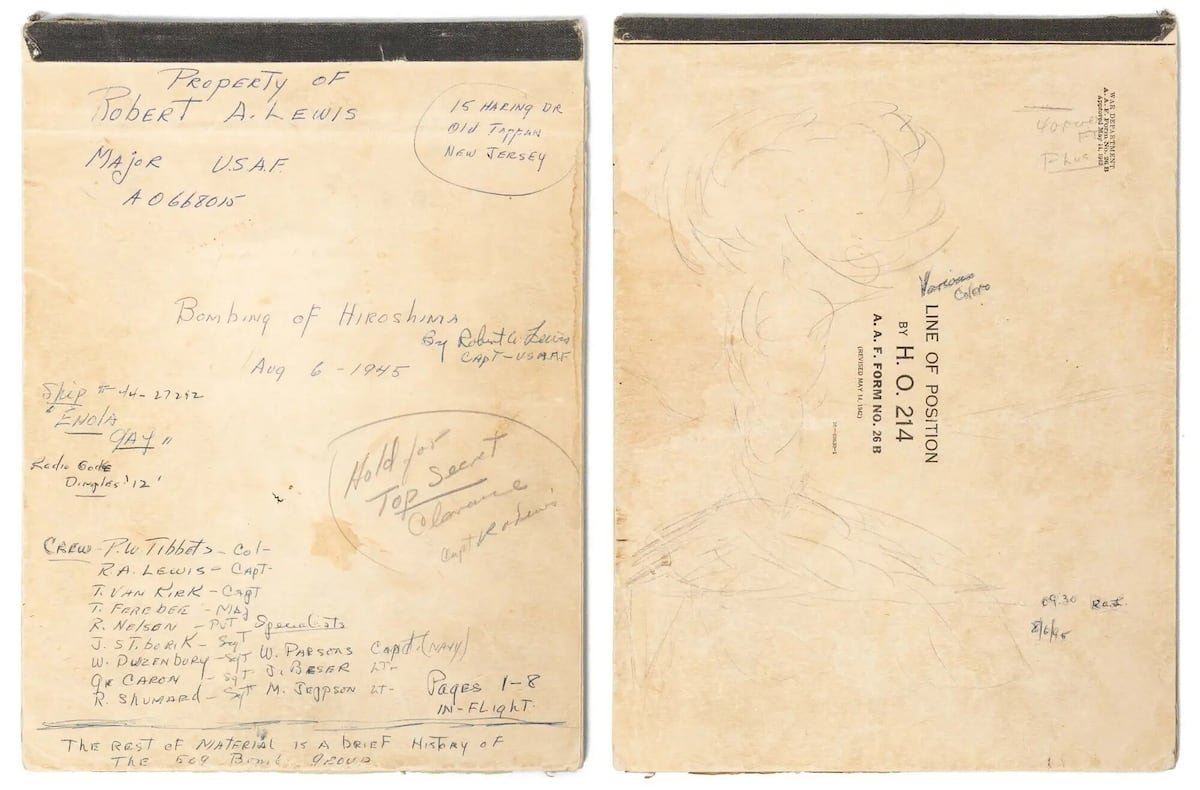
In a United States War Department-issued “Line of Position” notebook, Capt. Robert A. Lewis begins like many service member letters, with a “Dear Mom + Dad.” But this log, dated Aug. 6, 1945, is unlike any other entry from World War II.
Lewis, the co-pilot of the B-29 Enola Gay, was en route to Japan from the Pacific island of Tinian when he began recording. Now, his account, written during and in the immediate aftermath of dropping the first atomic bomb on Hiroshima, Japan, is for sale.
His “blow by blow description,” which includes his famous reaction: “My God what have we done,” has just been put up for sale by Dan Whitmore, a rare book dealer in Pasadena, California, the Washington Post was first to report.
The price: $950,000.
This will be the fifth time that Lewis’ record has appeared at auction: the first being sold for $37,000 by Sotheby’s in 1971. Lewis, present for the auction, reportedly said that he believed that the account was of great historical importance, adding that he “didn’t know what else to do with it.”
It sold once again for $85,000 at Sotheby’s in 1978; $391,000 at Christie’s in 2002 (as part of the Malcolm Forbes sale); and $543,000 at Heritage in 2022, according to Whitmore.
The eight-page account was made at the behest of William L. Laurence, a science writer for the New York Times, who received a Pulitzer Prize for his reporting on what he coined as the “Atomic Age.”
As the official historian of the Manhattan Project, Laurence was the only journalist to witness the Trinity test and the atomic bombing of Nagasaki. He was supposed to journey alongside Enola Gay’s crew but arrived too late at the bomber’s base on Tinian.
Over the course of the 12-hour flight from Tinian to Hiroshima and back again, Lewis “recorded both what he saw — including a sketch of the mushroom cloud over the city — and what he felt — apprehension, confusion, shock, awe — as he and his crew entered history,” according to the rare book dealer.
Much of Lewis’ writing occurred in near-total darkness, and as he notes, halfway through, he ran out of ink and finished his account in pencil.
Leaving the Pacific island at 2:25 a.m., Lewis recorded at 7:30 a.m. that “we are loaded, the bomb is now alive and it’s a funny feeling knowing its right in back of you. Knock wood. We started out climb to 30,000ft…well folks its not long now.”
As the B-29 approached the city, Lewis wrote: “There will be a short intermission while we bomb our target.”
At 8:15 a.m., the Enola Gay dropped the bomb.
“Little Boy” fell harmlessly for roughly 45 seconds before detonating, instantly killing 70,000 people in the initial blast. At least 100,000 deaths directly resulted from the attacks. A minimum of another 100,000 people also died from illnesses caused by radiation exposure in the weeks, months and decades that followed, according to the National Archives.
In that moment, Lewis wrote:
“We [Bob Caron our tail gunner] got excellent pictures and everyone on the shop is actually crossed out dumbstruck even though we had expected something fierce, it was the actual sight that we saw that caused the crew to feel that they were a part of Buck Rogers 25 century warriors. This essay on the bombing results could go on indefinitely by telling how huge it grew, even after an hour [and half.] [400] miles from the target, then the billow of smoke reached [5500] ft and contained very weird colors. But perhaps the Japs that are left can save me the trouble and let us know. We then headed ho[m]e on 150° and [our ship] sure had a happy [but puzzled crew]. Mission home was as briefed weather the same everyone got a few cat naps.”
Lewis, perhaps more reflective, later recorded in the days after the attack, “I am certain the entire crew felt this experience was more than anyone human had ever thought possible. It just seems impossible to comprehend. Just how many did we kill? I honestly have the feeling of groping for words to explain this … My God what have we done. If I live a hundred years I’ll never quite get these few minutes out of my mind.”
That later recollection was taped into place by Lewis shortly after the bombing. The yellowed tape, according to Whitmore, is still there.
In August 1945, Lewis was a confident, rambunctious 27-year-old with a reputation as a skilled pilot and determined ladies’ man. But the events of that summer day left him haunted.
In his later years, Lewis took to sculpture as a form of healing.
His piece — a mushroom cloud with streams of blood flowing down the side — was later given to Dr. Glenn Van Warrebey, an American psychiatrist who treated Lewis, seemingly for post-traumatic stress disorder.
According to the Washington Post, Whitmore has plans to exhibit the notebook at the New York International Antiquarian Book Fair, which begins April 30.
While there are two firsthand accounts of the Hiroshima bombing by the Enola Gay crew — the other being Theodore “Dutch” Van Kirk’s navigator’s log — only Lewis’ contains a uniquely emotional commentary of the day’s historic events.
Claire Barrett is an editor and military history correspondent for Military Times. She is also a World War II researcher with an unparalleled affinity for Sir Winston Churchill and Michigan football.
Read the full article here