
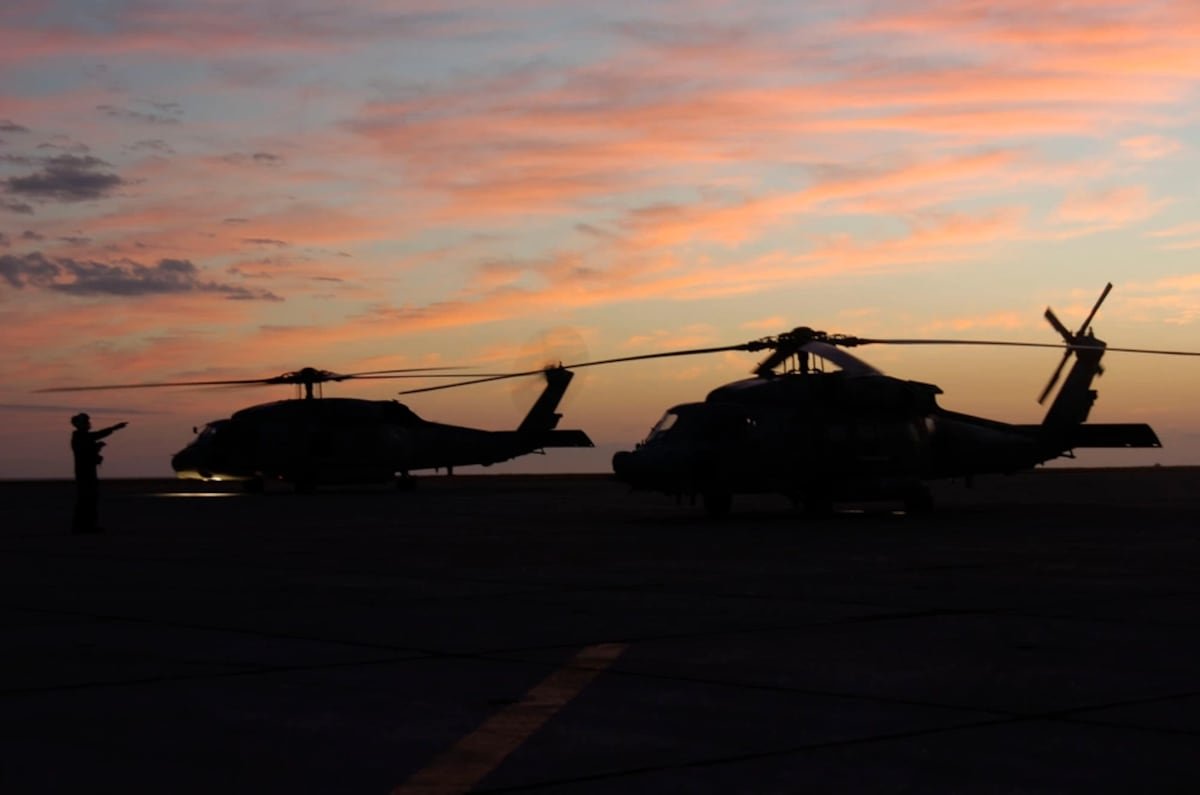
In 2022, Lt. Cmdr. Alex “Phrog” Vogel flew his 60-year-old C-2A Greyhound carrier onboard delivery aircraft from San Diego to Japan in a memorable mission that at times balanced on a knife’s edge of timing and logistics.
The relatively small plane required numerous and specific refueling stops at remote locations. But one leg of the trip — from the tip of Alaska’s Aleutian Island chain to Misawa, Japan — cannot be completed without carrying additional fuel onboard, Vogel said.
“It’s a little bit of a nail-biting experience to make sure that your fuel transfers properly and that your engines are running properly,” he said, adding that the flight’s emergency diversion option was Russia, and even that stopped being a possibility after a certain point.
Three pilots shared the workload, taking turns cycling up to the cockpit as barrels of gas were being pumped into the aircraft in the rear. Watching the plane’s fuel gauge tick up above zero, he said, was a massive relief.
The C-2 Greyhound made its final carrier landing at the end of June, capping off its mission as the Navy’s only carrier delivery passenger plane. The mission will now be conducted by the CMV-22, the Navy’s version of the tiltrotor V-22 Osprey.
On Thursday, the Norfolk, Virginia-based Fleet Logistics Support Squadron VRC-40, the last active C-2 squadron, will commemorate the aircraft with a special sundown ceremony. The final flight of the last C-2 is set to happen before the end of the month: a transit to its final home, the National Naval Aviation Museum in Pensacola, Florida.
Despite a no-fail mission to get VIPs and important cargo on and off carriers, the C-2 community is tiny, making up less than 1% of naval aviators, according to pilots who spoke with Military Times. Between 1,000 and 1,500 pilots have flown the aircraft since its first flight in 1960, Vogel said, a relatively small number in the scheme of naval aviation. That sense of eliteness, coupled with the way VRC squadrons conducted their overseas missions — with small detachments of two aircraft and about 50 personnel led by a lieutenant commander — fueled the development of a scrappy and self-reliant culture.
“I don’t think there’s anywhere else in the conventional military where so much is on such a junior group,” Cmdr. Paul “PETA” Ingram, the last commanding officer of VRC-40, said. “You’re operating independently overseas. You have to understand the Law of the Seas [and] the rules for international flying because there’s nobody there, nobody you can call on the radio back home, and nobody’s following you. You’re by yourself out there.”
Though C-2s caught the wire to land on a carrier and were catapult-launched off, just like fighter jets, they lacked the sophisticated computers and technology that have been added to platforms like the F/A-18 Super Hornet. C-2 pilots flew by controlling cables connected to hydraulic actuators, a throwback to a prior era.
“It’s a bit of a bear to fly, but at the same time … there’s no computers between you and the air, so it’s kind of unique in modern aviation to still be flying something that does that,” Ingram said, describing the plane as a “dinosaur.”
“It gives you just a sense of kind of pounding the air into submission,” he continued.
Ingram said he relished the rare vistas and unusual places that the work of C-2 crews gave them the chance to experience.
“Hands down, my favorite moment is just coming back from the ship, flying west from the North Arabian Sea into a sunset that just goes on forever because you’re chasing it over the Omani Mountains,” he said. There’s nothing quite like that — a sense of accomplishment; you just completed your mission — and then landing back home.”
The twin turboprop engine, high-wing Greyhound can carry up to 28 passengers, their seats facing the rear of the plane rather than the cockpit to absorb some of the shock of landing on the carrier. Passengers can be heads of state, journalists, foreign visitors or nonaviator service members, and the flight sometimes takes a toll. An arrested landing takes the plane from up to 138 miles per hour to a dead stop in less than two seconds. The catapult takeoff reverses that process. Nausea is not uncommon.
James Wallace, who flew the C-2 from 1979 to 1982, said the crew always tried to be on their best behavior, despite a plane that even then was often dingy and worn. He recalled crews carefully briefing the “always apprehensive” passengers, while trying to avoid getting dressed down by any senior officers who might be on board.
Once, he said, his crew transported the then-chief of naval operations, who later wrote a letter to the squadron to complain that the loadmaster had been chewing gum during the flight.
Vogel said the opportunity to give the carrier landing experience to enlisted troops and others who might never have it was one of the joys of flying the C-2.
“For all tailhook aviators, the most exciting thing you can do is land on the ship or take a catapult shot from the ship. And our platform is extremely unique in that we can provide that opportunity for 20 plus passengers at a time to experience what it feels like to land with a tailhook or take off with a catapult,” he said.
“And so having the opportunity to do that for everything from Make-A-Wish kids to high school teachers to foreign dignitaries of other nations is really rewarding — to be able to talk to them before the flight, and then after the flight, when they’ve you know finally experienced what what we get to do every couple of days,” he continued. “It’s really fun to see that transformation.”
That experience is now largely extinct: The Osprey, which lands and takes off vertically like a helicopter, doesn’t use the arresting wire or catapult.
The members of VRC-40 are now taking diverging paths. Some are transitioning to the Osprey community or to other platforms including the Super Hornet and the E-2 Hawkeye tactical early warning aircraft, which is fairly similar to the C-2. Others, like Vogel, are opting to retire.
They expect a crowd of 700 to attend the sundown event in Norfolk. A follow-up sundown event to reunite the community is already planned; it will be held Sept. 4-5 in San Diego, and details can be found at C2Sundown.com.
“It’s going to be emotional, I’ll tell you that much,” Vogel said of the upcoming events. “When we left the carrier for the final time about a month ago, all of us were pretty choked up flying away because it really signified the end of an era in naval aviation and our own lives … [but] we’re not going to stop seeing each other. That’s for sure.”
Read the full article here