

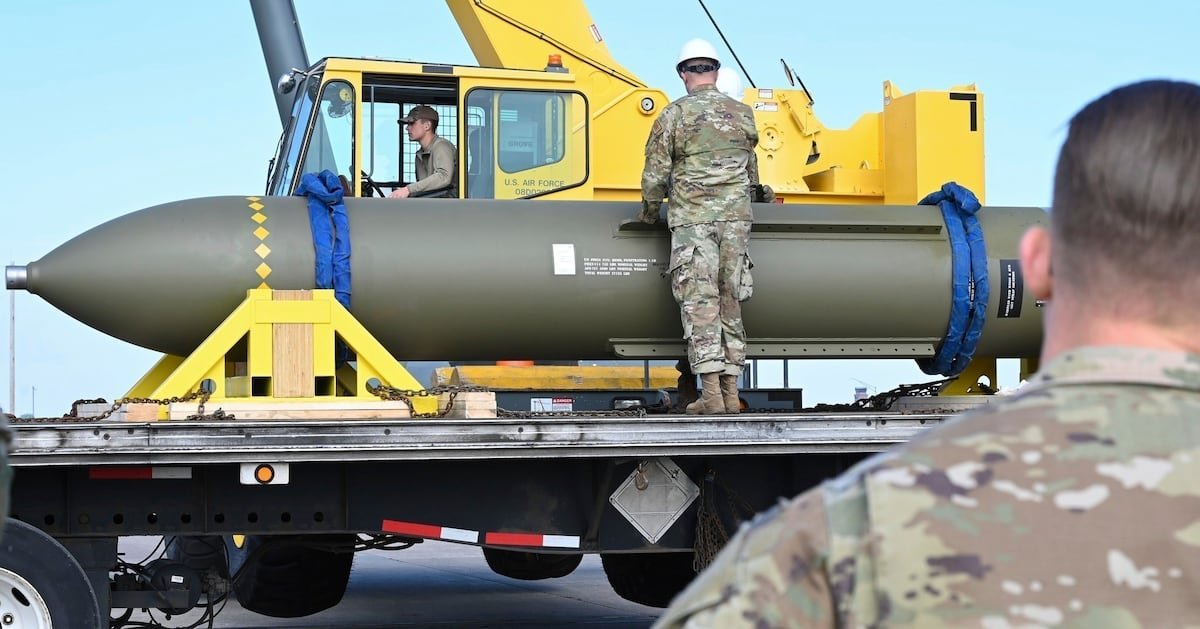
With nations such as Iran protecting their arsenals by burying them deep underground, the Pentagon’s Defense Advanced Research Projects Agency is searching for new types of bunker-buster bombs.
The goal is to go beyond the traditional brute-force approach of giant bombs that rely on the force of gravity to smash their way deep into the ground before exploding.
During World War II, the Royal Air Force dropped 22,000-pound “Grand Slam” bombs. Eight decades later, the U.S. Air Force has used the 30,000-pound GBU-57 Massive Ordnance Penetrator in the campaign against Iran.
Now, DARPA wants to pivot away from the traditional bunker busters and instead manipulate shock waves to destroy targets.
“The government is explicitly interested in concepts that move beyond traditional mass-velocity scaling and empirical design toward mechanisms that deliberately shape, steer, amplify, or suppress stress waves within homogeneous and heterogeneous materials,” according to DARPA’s Request for Information. The deadline is June 26.
“Areas of interest include, but are not limited to, transient material state manipulation under extreme loading, non-linear and anisotropic wave control, dynamic impedance matching, controlled failure initiation and progression, and the coupling of structural, material, and geometric effects to achieve step-change performance against complex targets,” DARPA continued.
DARPA also seeks “new regimes of performance or observability in shock-dominated environments.”
Potential advances include “architected or actively tunable materials, novel fabrication methods that embed function into structure,” and “advanced diagnostics capable of resolving high-strain-rate phenomena in situ.”
DARPA’s quest for better bunker-busters comes as the future of warfare heads beneath the surface. Iran has embedded nuclear facilities and missile stockpiles inside mountains. North Korea uses bunkers and tunnels to conceal nuclear sites, missile launchers and artillery.
Even non-state actors such as Hamas and Hezbollah — and before them, the Viet Cong — waged war from underground. In the Ukraine War, drones have become such a pervasive threat that human soldiers spend much of their time in bunkers.
Rooting out insurgents from tunnels is hard enough, as the U.S. Army’s “tunnel rats” can attest. Trying to destroy an Iranian nuclear site 300 feet underground is an order of magnitude harder.
That’s why weapons like Grand Slam and the Massive Ordnance Penetrator were invented. But the Grand Slam could be carried only by a specially modified Lancaster four-engine bomber, while the MOP is dropped by a B-2 bomber, of which the U.S. Air Force has only 19 operational.
DARPA’s RFI doesn’t mention reducing the size of bunker-buster bombs. But if scientists can devise ways to exploit shock waves to destroy targets, this opens the possibility of smaller bunker-busters that can be carried by a variety of aircraft.
Michael Peck is a correspondent for Defense News and a columnist for the Center for European Policy Analysis. He holds an M.A. in political science from Rutgers University. Find him on X at @Mipeck1. His email is mikedefense1@gmail.com.
Read the full article here