

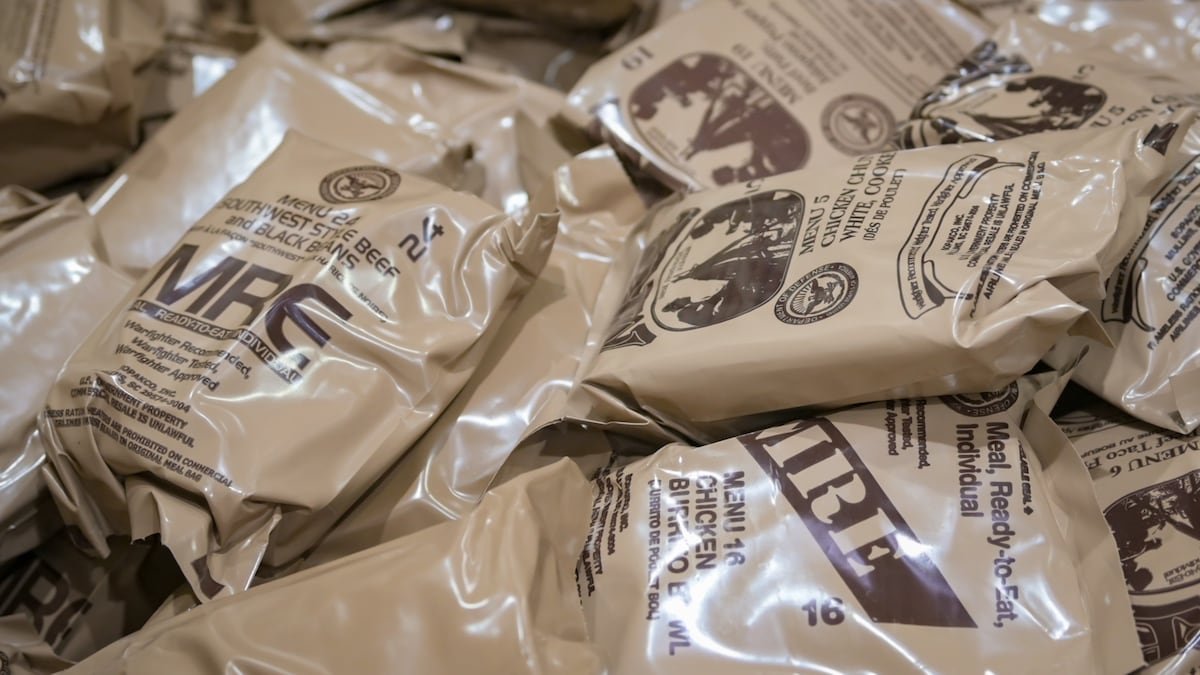
The U.S. Army is looking for meatless proteins for field rations. It also wants to manufacture such proteins on the front lines to ease burdens on the supply chain.
The service, according to a Sources Sought notice from the Combat Feeding Division of the Army’s Combat Capabilities Development Command Soldier Center, “is exploring how the emerging alternative-protein sector can help meet several objectives, including enhancing food supply chain resilience, enabling biomanufacturing of foodstuffs in combat-forward environments, and providing tailored, high-quality nutrition to the warfighter.”
Titled “Alternative Protein Technologies for Military Field Feeding,” the notice, which lists a deadline of May 15, is aimed at industry and academia that can work with the Army to develop technologies for manufacturing alternative proteins that soldiers will actually eat.
One track seeks “advanced technologies and processes, involved in fermentation, precision fermentation, or other novel biomanufacturing methods, that enhance the production of alternative proteins,” the notice reads.
“These technologies should focus on creating lightweight and nutrient-dense ration solutions to reduce logistical burdens and physical load on warfighters while maintaining or enhancing nutritional value and operational performance.”
Another track is to explore product development to create meatless proteins that are lightweight, nutritious, shelf-stable and “palatable.”
The Army also seeks partners who can help with consumer research, such as focus groups and tasting panels, to determine what military personnel like.
Also wanted are contractors who can provide food samples of alternative proteins that the FDA has classified as Generally Recognized as Safe, or GRAS, products.
“These prototypes will be provided to the government for sensory acceptability and other performance characteristics and will be consumed by our test panel of experts,” the notice said.
The alternative protein project is part of an Army Broad Agency Announcement published last year. It included research into combat rations, personal protective gear and other equipment.
It follows an Army plan announced last year to offer plant-based MREs, a decision that delighted vegan and animal rights groups.
In response to a mandate by Congress, the Navy began testing plant-based meats on its menus in 2023, while the Air Force offers meatless dishes.
While military rations have unique requirements such as remaining edible under harsh conditions, they do have to follow culinary trends in the larger society.
Thus, coming to the 2026 MRE menu are Buffalo Chicken, Cuban beef picadillo and Thai red chicken curry, meals that would have been regarded with disbelief — or appreciation — by GIs eating C-Ration meat stew in WWII, or the infamous ham and lima beans in Vietnam.
Plant-based meats, such as Beyond Burger, and non-dairy cheeses soared in popularity a decade ago. However, sales of plant-based meats have recently slumped as prices rose and consumers became concerned that faux-meat products are heavily processed.
Meanwhile, demand for beef soared in 2025.
Michael Peck is a correspondent for Defense News and a columnist for the Center for European Policy Analysis. He holds an M.A. in political science from Rutgers University. Find him on X at @Mipeck1. His email is mikedefense1@gmail.com.
Read the full article here