

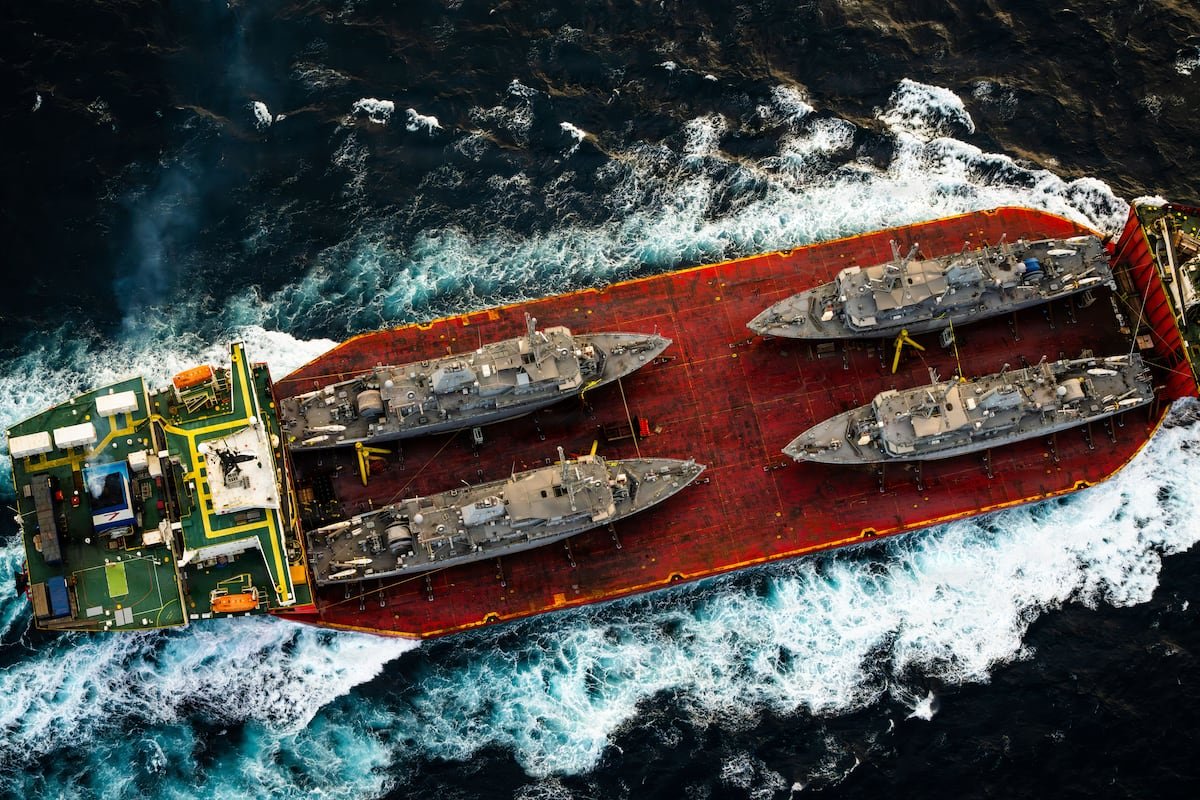
The U.S. Navy decommissioned half of its Avenger-class mine countermeasure ships last year and began replacing them with littoral combat ships that possess anti-mine capabilities.
Naval mine warfare is a major tenet of Iran’s Islamic Revolutionary Guard Corps Navy military doctrine, according to a 2017 Office of Naval Intelligence report, and looks to be a factor in the ongoing Iran war.
Iran reportedly began laying mines in the Strait of Hormuz this week, with U.S. Central Command announcing Tuesday that it had struck 16 Iranian mine-layers.
The U.S. remains confident that it’s new phase of mine countermeasure capabilities can successfully thwart mine warfare.
“The [littoral combat ship] MCM mission package is a sophisticated suite of manned and unmanned systems designed to locate, identify, and neutralize sea mines, at a safer distance from minefields than the Avenger-class MCMs,” a Navy official told Military Times on the condition of anonymity.
Independence-class littoral combat ships equipped with the mine countermeasures mission package began arriving in the U.S. Fifth Fleet last year to replace the decommissioned minesweepers in Bahrain.
The USS Canberra was the first LCS with the MCM package to arrive in the Middle East on May 22. The USS Santa Barbara and USS Tulsa, two other littoral combat ships with the MCM package, were also stationed in the U.S. Fifth Fleet as of Sept. 25, 2025, with a yet-to-be-named fourth LCS on its way, according to USNI News.
Unlike the minesweepers, which have a long history of being battle-tested, the LCS with the MCM package has never been deployed in combat.
If the LCS is used during Operation Epic Fury to address Iranian mines, it will be a first.
The LCS with the MCM package possesses similar counter-mine capabilities as minesweepers, but the fundamental difference is that the LCS operates outside the mine threat zone and deploys counter-mine devices, while the minesweepers can operate near or directly inside the mine-threat zone.
Minesweepers boast a non-magnetic signature and low acoustic footprint designed to avoid triggering sea mines, allowing them to operate closer to dangerous areas.
They deploy a bevy of resources to destroy and disable moored and bottom mines, including sonar, cable cutters and mine detonating devices.
RELATED
Beginning in the 1980s, the U.S. manufactured 14 deployable Avenger-class ships in total, according to the Navy.
The ships were deployed in the Persian Gulf during the Iran-Iraq war, Operation Desert Shield and Operation Desert Storm.
After the Gulf War, U.S. Avenger-class minesweepers participated in efforts to hunt down more than 1,000 mines off of Kuwait that Iraq laid.
Retired Navy Capt. Sam Howard, who commanded the Osprey-class USS Raven minehunter, said there were several ways minesweepers targeted and vanquished the the threat of naval mines.
He broke the process down into two categories.
“There’s mine hunting and then there’s minesweeping,” Howard said.
Ideally, the Navy would typically rely on airborne countermeasures to accomplish mine hunting, Howard said, such as the MH 53 Sea Dragon helicopter, which used side-scan mine hunting sonar in order to map out what lay beneath the water.
This way, fewer ships were put at risk and helicopters also covered more water at a faster pace.
Minesweepers could mine hunt if they needed to, but it would take much longer, as they were slower and couldn’t cover as much width. In this instance, the ship would use its high-frequency sonar and a tethered remote operating vehicle that could go out and confirm the presence of mines, Howard explained.
Once a large number of mines were identified and mapped, the minesweeper or a helicopter could go about detonating the mines through acoustic or magnetic triggers, depending on which type of mines were being targeted.
An acoustic device used by a helicopter or a minesweeper would emit noise or a frequency meant to trigger mines that explode from sound, Howard added.
For electromagnetic denotation, the U.S. Navy would use the Mark 105 Hydrofoil Magnetic Minesweeping Sled, he said, which emits a magnetic field designed to trick mines into exploding.
For moored mines, which were anchored to the seabed and attached to a tether hovering near the water’s surface, a minesweeper would tow a series of cables and cutters behind it to cut the tether and make the mine rise to the water’s surface, at which point it would be destroyed by various means.
The USS Devastator, USS Dextrous, USS Gladiator and USS Sentry — which were all stationed in Bahrain in the Middle East — were put to pasture in 2025 after each serving for over 30 years, leaving only four remaining minesweepers in the U.S. Navy fleet.
Those remaining Avenger-class minesweepers are currently forward deployed to the U.S. 7th Fleet at U.S. Fleet Activities Sasebo, Japan.
It remained unknown Thursday if the Pentagon intended to forward deploy minesweepers from Japan to the Middle East in support of Operation Epic Fury.
But the Navy was not backtracking on their plans toward modernizing mine countermeasure forces.
“The Navy has no plans to recommission any Avenger-class Mine Countermeasures Ships,” a Navy official told Military Times.
Riley Ceder is a reporter at Military Times, where he covers breaking news, criminal justice, investigations, and cyber. He previously worked as an investigative practicum student at The Washington Post, where he contributed to the Abused by the Badge investigation.
Read the full article here