

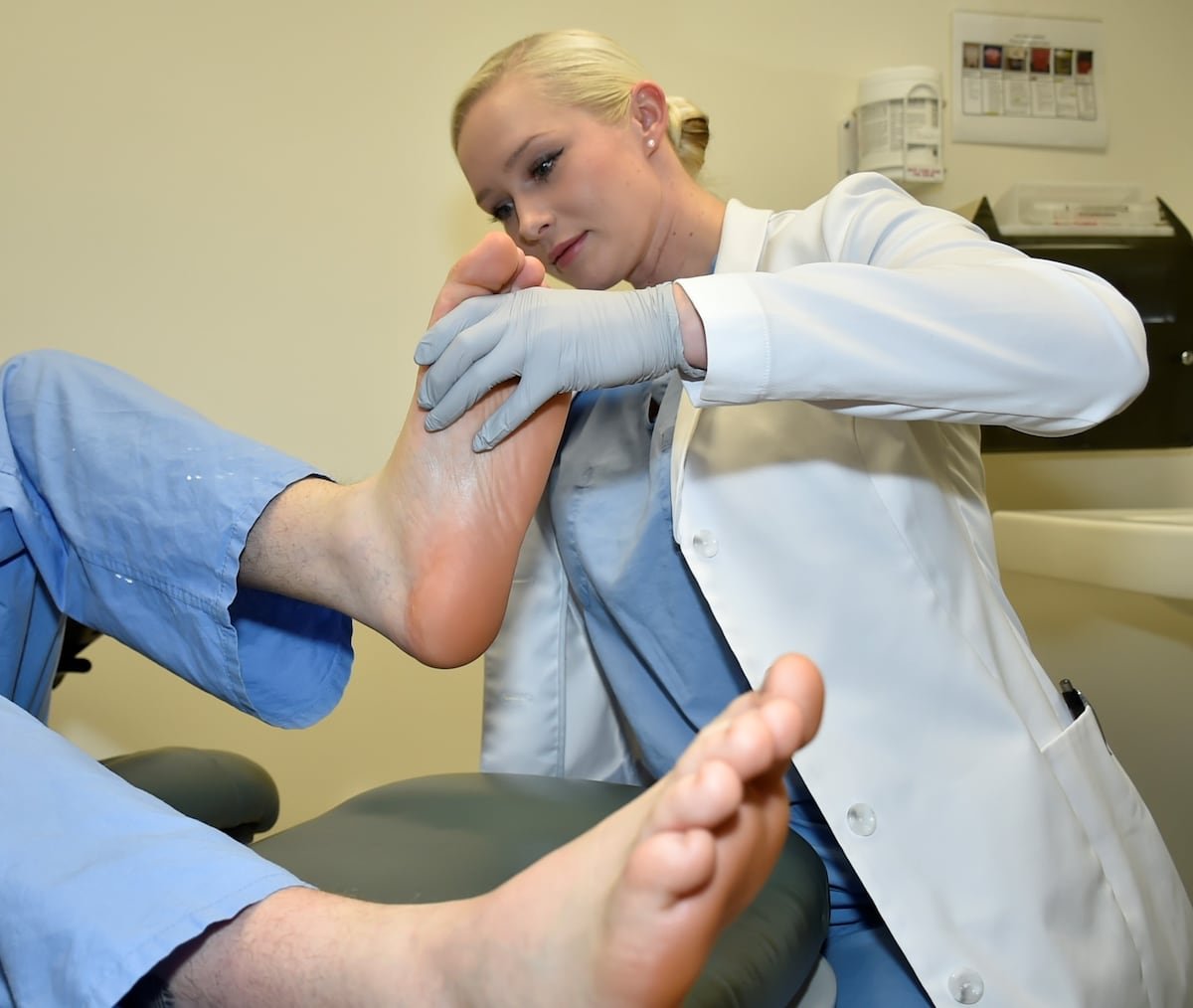
A new $3.4 million Pentagon grant to two universities aims to help solve the thorny problem of military recruits getting sidelined with stress fractures.
The grant, which covers four years, was awarded to Rosalind Franklin University in Illinois and Old Dominion University in Virginia. According to a release from Rosalind Franklin, bone-stress injuries affect up to 8% of military recruits across the services and cost the Department of Defense about $100 million per year in medical expenses alone.
“Because suspected stress fractures often require serial clinical visits, radiographs, MRI and bone scans, there is a strong operational and economic incentive to improve early diagnosis and risk stratification,” school staff said in the release.
The objective of the grant is to develop a “clinically actionable” test that flags biomarkers in urine, creating a non-invasive way to detect bone-stress injuries in the legs before they lead to fractures and other more severe, sidelining conditions.
“[Bone stress injuries] are a major challenge to military readiness,” Shawn Flanagan, director of the Human Performance Laboratory at Rosalind Franklin’s Center for Lower Extremity Ambulatory Research (CLEAR), said in a statement. “By combining cutting-edge proteomic methods with access to large, well-characterized military cohorts, we aim to create a biomarker panel that safeguards recruits and enhances operational performance.”
Founded in 2004, CLEAR is a leading center for research to make “measurable improvements in the health and function of the lower extremities,” according to its website, with specialties in diabetic complications and biomechanics.
The team of researchers, which, according to releases, will include military professionals and experts in proteins, musculoskeletal physiology, bone imaging and military health, will study cohorts of military recruits over time to validate testing panels, and include gender-specific analyses to evaluate any differences between male and female recruits.
The release does not say where the research will be conducted or what services will be involved.
The new research grant comes on the heels of military research that expands what’s known about military stress fractures and who’s most at risk. A Uniformed Services University study published in the Journal of Military Medicine in June assessed 446 patients at Walter Reed National Military Medical Center who sustained a total of 537 stress fractures over three years.
It found that recruits were more likely than longer-serving service members to sustain leg and pelvis fractures, but less likely to sustain foot fractures. New recruits were also significantly more likely than other groups to sustain multiple stress fractures.
“Providers may consider having a lower threshold for imaging new recruits with hip pain as this could identify a stress reaction before it becomes a stress fracture,” the study concluded.
The prospect of a non-invasive test that flags biomarkers for stress fractures is all the more appealing because they can be difficult to confirm with conventional approaches.
“[Bone stress injuries], particularly hips, can be tricky to diagnose as the pain level doesn’t always equal the severity level, and X-ray imaging doesn’t always show early BSI,” Army Maj. Gary Helton, assistant chief of the Fort Jackson Department of Sports Medicine, said in a 2025 release. “Tibial BSIs, and hip BSIs, particularly the femoral neck, can lead to a complete fracture needing surgery if not addressed in a timely manner.”
An ongoing Army study aims to identify trends and risk factors for BSIs, giving providers more opportunities to prevent severe injuries through better evaluation techniques.
Read the full article here