
NEW TAIPEI CITY, Taiwan — U.S. President Donald Trump’s apparent move to delay a massive weapons sale to Taiwan after a summit with his Chinese counterpart will drive the island’s military further toward self-sufficiency, with sights on asymmetric warfare rather than technological might if ever in a war with China, analysts say.
Days after Trump met Chinese President Xi Jinping in Beijing, the U.S. acting Navy secretary said a $14 billion arms package to Taiwan had been delayed. The president is due to announce an update the package’s status, Taipei-based Central News Agency reported on May 23.
Although it’s unclear whether Trump will stick to his pledge, scrap it or wait to see whether China comes through on large purchases of American imports as a reciprocal gesture, experts in Taiwan said the delayed sale represents an interim pullback in U.S. commitment to Taiwan’s defense.
“U.S. arms sales to Taiwan have never been merely about weapons acquisition,” said Huang Chung-ting, associate research fellow with the Institute for National Defense and Security Research in Taipei.
“They are also a visible form of political credibility, commitment credibility and allied trust,” he said. “Beijing may become more likely to underestimate U.S. resolve to intervene, while the deterrent significance originally carried by Taiwan’s arms purchases would also be diluted.”
The idea of Trump using arms sales as a negotiating chip with China has sparked concerns in Taipei that Washington might decline procurement deals with Taiwan until the president leaves office, said Huang Kwei-bo, a diplomacy department professor at National Chengchi University in Taipei.
U.S. arms sales to Taiwan are a longstanding source of friction between Washington and Beijing. China has claimed sovereignty over self-ruled Taiwan since the late 1940s and never dropped the threat of force, if needed, to unify the two sides. Since mid-2022 the People’s Liberation Army forces have stepped up flybys and large-scale exercises in the Taiwan Strait.
Worries about the U.S. commitment would refocus Taiwanese officials on indigenous weapons development, experts said.
“Attempts will be made to shift to further self-reliance, particularly with regard to the drone industry, and building up the munitions industry,” said Brian Hioe, a non-resident fellow at the Taiwan Research Hub of the University of Nottingham.
“Ironically, having to take into account the possibility that the U.S. does not provide Taiwan arms may push Taiwan further toward asymmetric defense, rather than reliance on big-ticket items — as the U.S. has called on Taiwan to do,” he said.
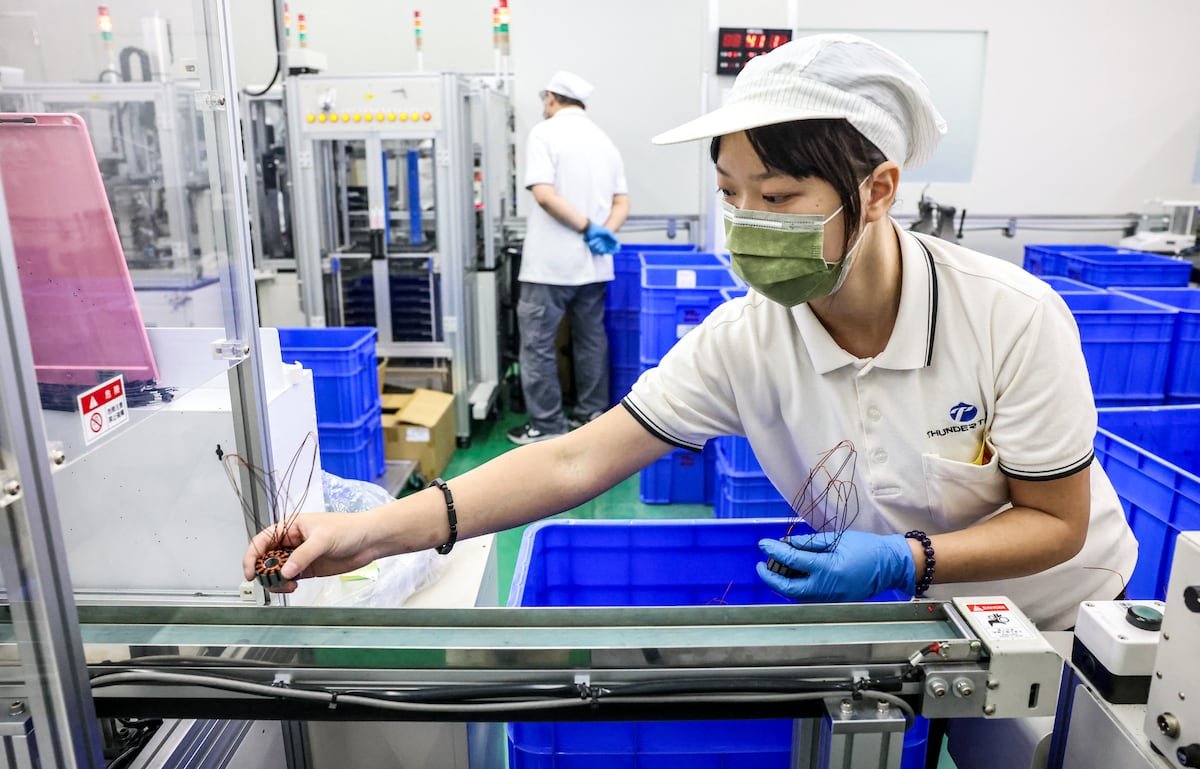
The island long known for a range of high-tech manufacturing for the past 50 years has pursued its own air defense system, advanced anti-ship missiles and a submarine fleet. In February, Taiwan President Lai Ching-te announced an eight-year budget to modernize the military and what he called “asymmetric capabilities across seven major categories”.
Asymmetric air and sea warfare refers to a numerically weaker force fighting off a stronger one through unconventional means. China’s armed forces are larger than Taiwan’s.
But Taiwan still lacks an indigenous, unified system capable of both interception and counterattack, said Chen Yi-fan, assistant professor in the Diplomacy and International Relations Department at Taiwan’s Tamkang University.
Domestically produced munitions, he added, are not yet “fully integrated into a comprehensive defense network,” and Taiwan doesn’t have enough Patriot Advanced Capability-3 air defense missile system and Army Tactical Missile System to protect strategic assets and critical infrastructure from attack. Lockheed Martin makes both. Patriots, or PAC-3, are in the package that’s now paused.
If Trump were to green-light the $14 billion package, the PAC-3 would take four to five years for delivery because “defense production capacity has long lagged behind demand,” Chen added.
A top U.S. envoy to Taipei said after the May 13-15 Trump summit in China that U.S. Taiwan policy hasn’t changed. A commitment to help Taiwan’s self-defense has anchored that policy since 1979.
A deputy minister with the Taiwan government’s Mainland Affairs Council also said in a May 18 statement that U.S. policy toward the island had “not changed” since the Trump-Xi summit and that Washington made “no promises” to China on arms sales.
Before the apparent pause in Washington, Taiwan’s government had approved a $9.34 billion special defense budget for a weapons the United States had already approved. Purchases would include High Mobility Artillery Rocket Systems (HIMARS) and Javelin anti-tank missiles.
Read the full article here