

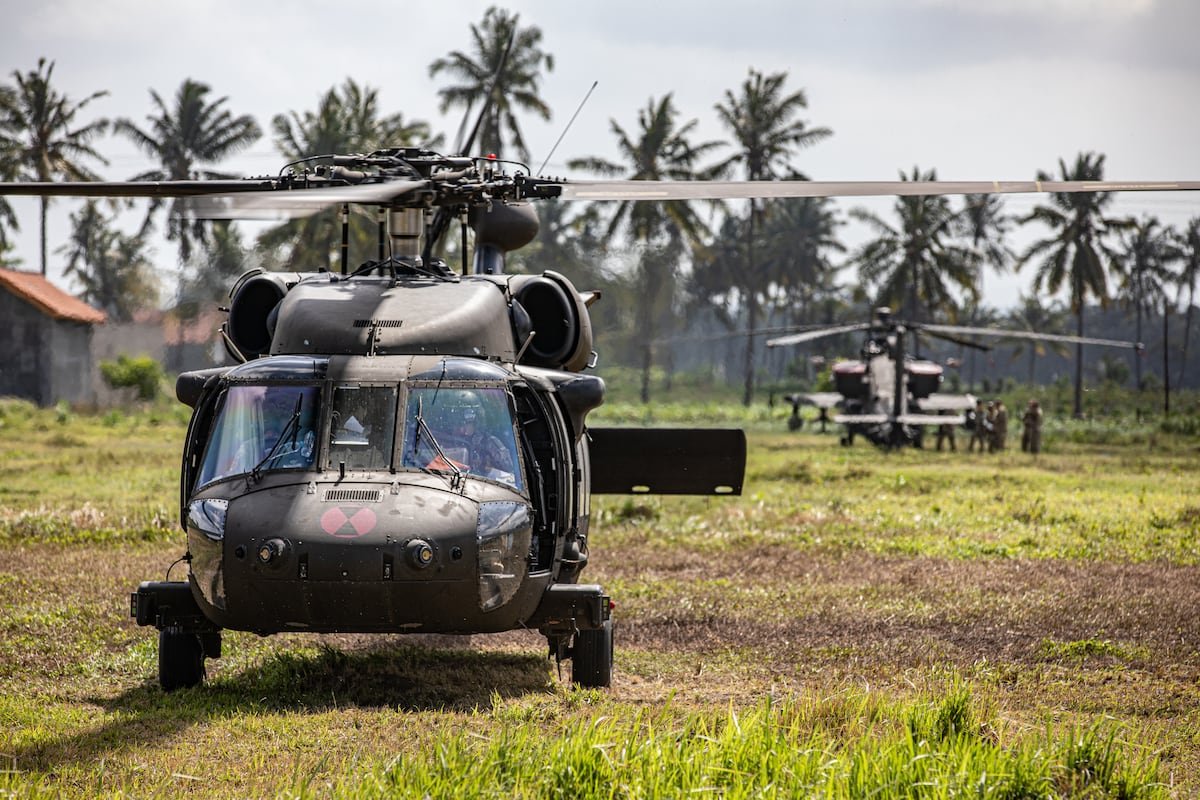
HONOLULU — The U.S. Army is continuing to tweak its formations to position the service for success in future fights, with the latest move the establishment of the Multi-Domain Command-Pacific, or MDC-PAC.
The new two-star command will combine the 7th Infantry Division and the 1st Multi-Domain Task Force, Army leaders announced during the 2026 Land Forces of the Pacific Symposium and Exposition in Hawaii.
Speaking to reporters at the symposium, U.S. Army Lt. Gen. Matthew McFarlane, commanding general of I Corps and Joint Base Lewis-McChord, Washington, where the merging units are headquartered, lauded the change as a forward-looking departure from the days “when we’ve waited till all the equipment was produced and [then] created the formations.”
“We made the formations to test and integrate the equipment, and we’re adjusting,” McFarlane said. “We’re keeping an agile posture with making organizational changes.”
While McFarlane acknowledged the Army is still working through organizational details, he did note that the command would merge the 7th ID’s two Stryker brigades and a combat aviation brigade with a multidomain task force — or “forces,” he said — to share fires, space, electronic warfare, cyber and intelligence capabilities with other commands and services throughout the Indo-Pacific.
As part of the transition, which is slated to begin in mid-June, soldiers with the 1st MDTF will “re-patch” into the 7th ID.
The timing of the move, McFarlane added, is reflective of Corps-level successes during recent exercises and war games that replicated what a two-star merger might look like.
“We have opportunities to make sure we’ve got the right mix of capabilities with a two-star command,” he said. “The Stryker brigades obviously provide security on the ground, so it really becomes long-range sense and strike division. … That’s important because [this command’s] effects can range the entire joint operational area versus just a corps-level battlespace. That’s exciting for the Army.”
The establishment of the far-reaching MDC-PAC, meanwhile, comes as Army leaders continue to hammer home the importance of Indo-Pacific collaboration to curtail emerging threats out of China and North Korea.
Speaking at LANPAC, Brig. Gen. William Parker, commander of the 94th Army Air and Missile Defense Command, acknowledged that the U.S. military “can’t do any of what we do today without allies and partners.”
“We don’t fight alone, and we haven’t fought alone for a long time,” he said. “Our partners help us protect our critical assets and critical formations that we have within this theater.”
Days before the start of the symposium, the U.S. military wrapped up the 41st iteration of Exercise Balikatan, the largest annual bilateral exercise between U.S. and Philippine militaries.
This year’s 19-day exercise was also joined by Australia, Japan, New Zealand, France and Canada, the latter four of which put troops on the ground for the first time as part of the exercise.
“Balikatan 2026 marked a strategic evolution from a bilateral exercise to a full-scale, multinational mission rehearsal for the defense of the Philippines,” U.S. Navy Adm. Samuel J. Paparo, commander of U.S. Indo-Pacific Command, said of the event. “That growth reflects the security environment. It reflects the sovereign choices of free nations.”
J.D. Simkins is Editor-in-Chief of Military Times and Defense News, and a Marine Corps veteran of the Iraq War.
Read the full article here