

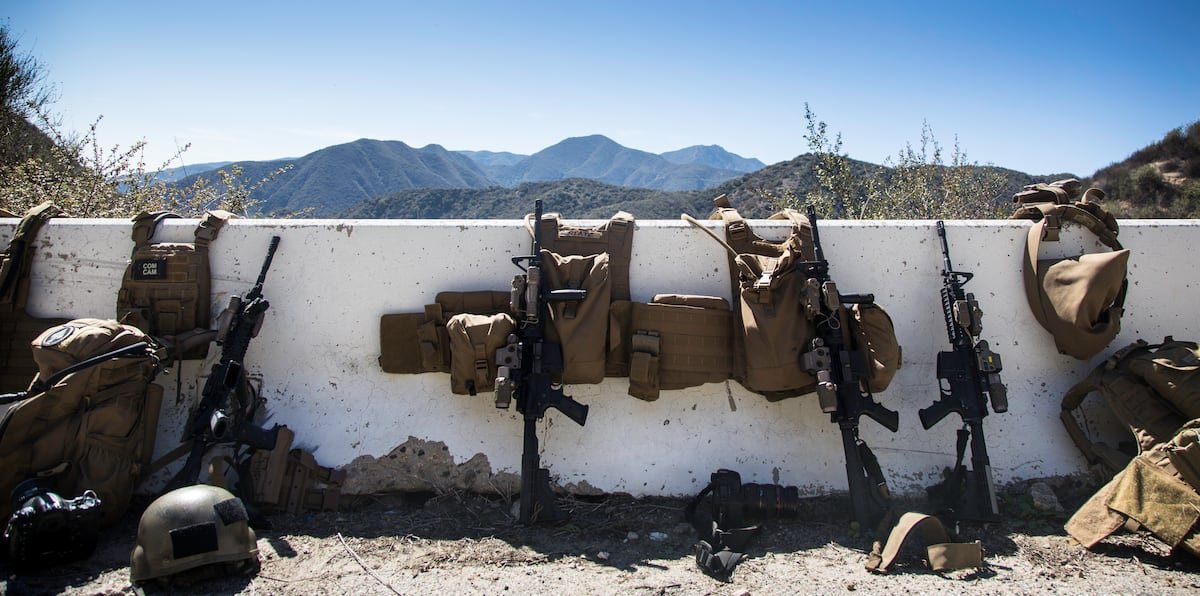
The U.S. Marine Corps is looking to acquire high-resolution 3D scanners to detect cracked body armor.
The goal is to develop sensors that can “scan individual hard armor plates for cracks and delaminations,” according to a Marine Corps Request For Information, which is due Oct. 2. More specifically, the devices will inspect Enhanced Small Arms Protective Inserts and United States Marine Corps Lightweight Plates.
The Enhanced Armor Inspection System will use computed tomography, or CT, scanners. CT scanning, commonly used for tasks such as medical imaging and airport bomb detection, creates 3D images that are more detailed than traditional 2D X-ray images.
The Marine Corps intends to set up 10 CT scanners for body armor inspection. This includes six devices in the continental United States, two in Japan and one each in Hawaii and Guam.
The Marine Corps currently uses two techniques to spot defects in body armor, as explained in a 2023 Small Business Innovation Research solicitation that sought new methods of examining cracked ceramic plates and delaminated polyethylene layers. Cracked ceramics are detected by X-rays and deformed polyethylene by tapping the armor and determining whether the sound is like a chime (good) or a thud (bad).
The SBIR did point to CT scanning as an alternative, but noted that “this method is extremely expensive and requires highly trained personnel.”
The new RFI seeks an automated commercial system. It should include an “automated material custom conveyance & sorting system, imaging system, and data processing/handling that is fully equipped with customized Automated Defect Recognition (ADR) software to meet the USMC’s requirements.”
Contractors should specify how many plates per minute their systems can examine. They are also asked to describe how well the scanners can handle “materials with varying densities or compositions, such as the blend of boron carbide and silicon carbide, or the presence of metal crack arrestors.”
In 2011, a Department of Defense Inspector General audit found that the U.S. Army had purchased 5.1 million ballistic inserts that might have been defective. Army tests sometimes failed to use the correct-sized armor plates, the proper velocity for bullets fired at the plates or assess the effects of weathering and altitude.
The Army replied that there was “no case in which the military’s body armor has failed to do its job in protecting troops in Iraq and Afghanistan.”
There have also been claims of defective military body armor in Britain and Taiwan, as well as for U.S. police departments.
Michael Peck is a correspondent for Defense News and a columnist for the Center for European Policy Analysis. He holds an M.A. in political science from Rutgers University. Find him at theuncommondefense.com. His email is mikedefense1@gmail.com.
Read the full article here