

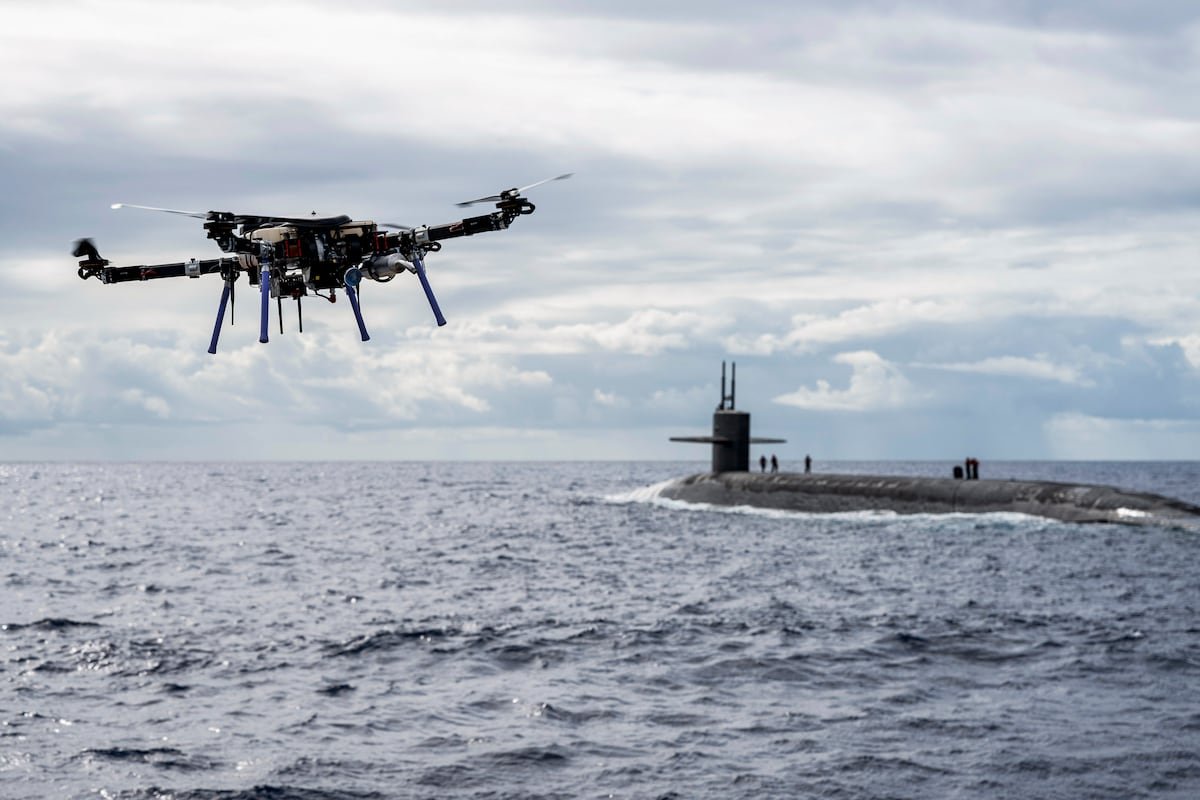
When hidden deep in the vastness of the ocean, America’s ballistic missile subs are practically invulnerable.
But berthed in port — or sailing on the surface while transiting to and from port — these powerful yet fragile boats can be sitting ducks for drones, mines and even anti-tank rockets.
What once seemed the plot of thriller novels has become reality. Ukraine claims it successfully used an underwater drone to damage a Russian submarine in the Black Sea port of Novorossiysk last year. Guerrillas and terrorists lurking along a waterway could use anti-tank guided missiles or handheld anti-tank rockets to ambush an unwary sub.
To face the new threat, the U.S. Navy is looking to develop better methods of protecting its missile subs, as well as the shore installations that support them.
These defenses include “prototype technologies to detect, track, identify, deny, and defeat unmanned systems across all domains,” according to a Sources Sought announcement. “This area seeks scalable solutions for shore-based installations and afloat operations in Port, Harbor, Littoral, and Waterways (PHLW) and open ocean environments.”
The Navy is also searching for ways to escort and protect its missile subs as they transit to and from port.
The goal is to “ensure the zero-failure secure movement of strategic maritime assets,” the announcement said. “This area seeks advanced maritime situational awareness, physical security enhancements for escorting SSBNs [nuclear missile subs], and the detection, avoidance, and mitigation of maritime mines, and the defeat of direct-fire kinetic threats (e.g., shore-launched ATGMs/RPGs) during transit through PHLW to and from dive points.”
The threat of anti-tank weapons even extends to the truck convoys hauling ICBMs to sub bases. The Navy is interested in active protection systems — sensors and shotgun-like launchers mounted on armored vehicles to destroy incoming anti-tank rockets — “for ground transport and convoy operations of strategic weapons and equipment.”
Other security items in the Sources Sought announcement, which lists 22 “focus areas” that the Navy’s Strategic Systems Program wants to address, include sensors to protect harbors. The Navy is also interested in security robots, including “Unmanned Surface Vehicles (USVs) for waterside patrol, Unmanned Ground Vehicles (UGVs) for perimeter screening, and robotic inspection platforms that seamlessly integrate with existing response forces.”
Artificial intelligence has also emerged as a threat in the form of drone swarms or cyberwarfare.
The Navy is searching for countermeasures that “focus on defeating autonomous swarms, disrupting AI-enabled Intelligence, Surveillance, and Reconnaissance (ISR) directed at nuclear facilities, and hardening strategic security networks against AI-driven cyber-physical attacks or spoofing.”
The best defense for submarines is simply not to be detect in the first place. To that point, the Navy is seeking “prototype technologies that may mitigate the generation, radiation, propagation, and scatter of a variety of signal types (acoustic, chemical, optical, electromagnetic, radiological, hydrodynamic, and cyber) associated with submarine and unmanned system operations, to include both peacetime and wartime operations.”
Michael Peck is a correspondent for Defense News and a columnist for the Center for European Policy Analysis. He holds an M.A. in political science from Rutgers University. Find him at theuncommondefense.com. His email is mikedefense1@gmail.com.
Read the full article here