

As the Iran war has shown, detecting and sweeping mines is one of the biggest challenges for the U.S. Navy. Meanwhile, the sea service also has to worry about detecting submarines operated by China, Russia and other nations.
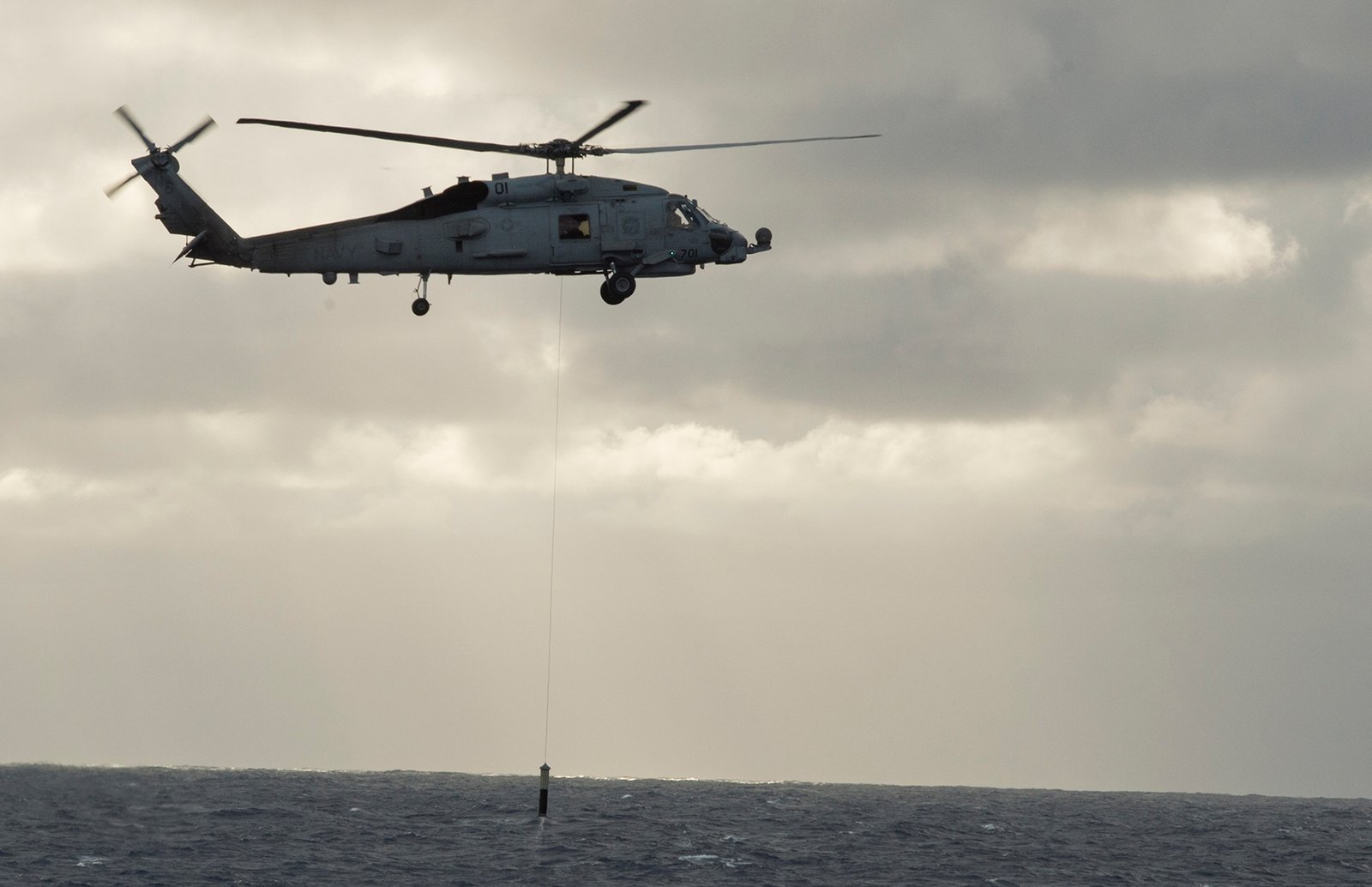
But rather than separate sonars and helicopters for spotting mines and subs, the Navy is exploring the convenience of having one sonar that allows a single helicopter to perform both missions.
The service, therefore, is looking for a helicopter-borne dipping sonar capable of both anti-submarine warfare, or ASW, and airborne mine countermeasures, or AMCM.
“The multi-mission capability of such a sonar transducer assembly would also allow one aircraft, without reconfiguring, [to] cover both ASW and AMCM mission sets for reduced maintenance and reducing the equipment needed to be stored while afloat in space-constrained ships,” explained the Navy Small Business Innovation Research solicitation, which opens May 6 and closes June 3.
The sonar would be mounted on multi-mission helicopters. It would also be suitable for the Navy’s upcoming maritime strike future vertical lift platform, which will replace aging MH-60R and MH-60S helicopters.
Historically, acoustic ASW and AMCM have been different fields, with anti-submarine sonar and sonobuoys installed on medium-lift helicopters, and mine detection systems installed on heavy-lift helicopters.
Yet previous and “minimally funded” efforts to use ASW sonar for mine detection “have shown success in detecting nearly every naval mine based on post-flight data analysis,” according to the Navy.
“Enhancing that capability with a secondary frequency band and associated beam steering, as well as uniquely developed pulses and processing across both frequency bands, is expected to provide a significant AMCM capability while retaining both traditional ASW superiority and enhanced ASW detection and classification capabilities for certain scenarios,” the solicitation said.
The SBIR lists a variety of desired technical specifications, including a weight of less than 180 pounds, a stowed diameter no greater than 210 millimeters and an overall length no greater than 1,275 millimeters.
The device should be capable of inner- and middle-zone submarine detection. The primary acoustic transmit band for ASW would operate at 3 to 5 kHz, while a higher-frequency secondary band would handle AMCM.
In addition, “it would be a significant advancement in helicopter-based ASW capabilities if a tertiary frequency band below 2 kHz was also added to expand mission capabilities to broach wide area search and explore advantages of convergence zone type capabilities,” according to the solicitation.
Given that sonobuoys cost less than $15,000 apiece, “a highly capable sonar transducer design would be capable of being generated with a much more reasonable forecast production cost well below $500,000 each,” the service noted.
Phase I of the project involves scale electronic models, and using analysis and simulation to demonstrate inner- and middle-zone ASW as well as the ability to detect floating, moored and bottomed mines.
Phase II calls for a prototype that can be fitted on a Navy ASW-capable helicopter.
Phase III would see the prototype flight tested aboard an MH-60R in both ASW and AMCM scenarios. Dual-use applications include commercial undersea mineral exploration, and recovery of ships and aircraft lost at sea.
Michael Peck is a correspondent for Defense News and a columnist for the Center for European Policy Analysis. He holds an M.A. in political science from Rutgers University. Find him on X at @Mipeck1. His email is mikedefense1@gmail.com.
Read the full article here