

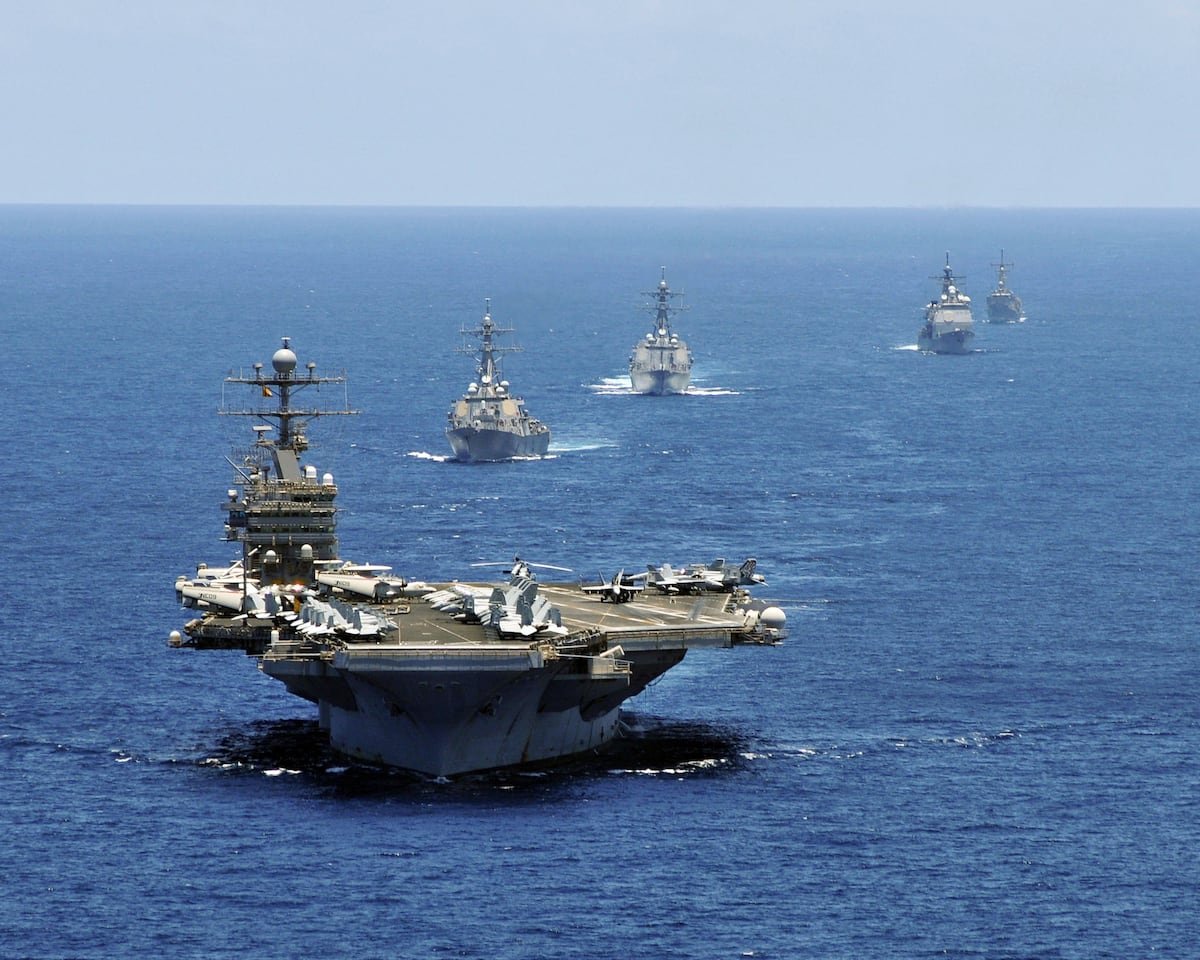
As the USS Abraham Lincoln pulls into port 321 after first leaving Naval Station San Diego, it will do so with another notch on its historic belt after Defense Secretary Pete Hegseth announced Wednesday that the carrier strike group had been awarded the Presidential Unit Citation, the military’s highest unit-level valor award.
Hegseth, who visited the carrier one day prior to the ship reaching shore, announced the award to the 5,000 sailors aboard the Lincoln, citing the “historic mission” that included completing “3,693 combat flights, sinking 64 Iranian warships, launching 450 Tomahawk land attack cruise missiles and shooting down 77 one-way aerial attack drones.”
“You have changed the arc of history, ensuring that crazy people, theocrats, never get a nuclear weapon,” Hegseth said.
The first ship in Carrier Strike Group 3, destroyer USS Frank E. Petersen Jr., returned to Hawaii on Sept. 28, while the Lincoln continued to sail towards the California coast.
“Congratulations to @CNV_72 and all of CSG-3 on this well-earned Presidential Unit Citation for their extreme heroism over the last 10 months in defense of our homeland,” Acting Secretary of the Navy Hung Cao wrote on social media.
That defense included 40 days in combat and an “ironclad maritime blockade against Iran in support of Operation Epic Fury,” according to the citation.
The increasingly long deployments of U.S. vessels — the USS Gerald R. Ford returned to its home port in May 2026 after a record 327-day deployment — have raised growing concerns regarding the demand of prolonged combat deployments.
Public concern over deteriorating mental health aboard the Abraham Lincoln and within the carrier group grew to a crescendo in mid-August, when Military Times reported that two sailors attempted to jump overboard the USS Abraham Lincoln. The carrier, at that time, had gone 265 consecutive days without a port call.
Cao confirmed on Sept. 22 that eight sailors aboard ships from the USS Abraham Lincoln carrier strike group attempted suicide but also said that no sailor had died from the attempts.
“There were some in the media who wanted to mischaracterize your great success or characterize it as something else,” Hegseth said. “Some in the media … wanted to define your mission by that. Or make it seem that that was all that people should take away.”
Hegseth refuted that characterization, instead noting faces “beaming with pride” aboard the ship — “and rightfully so,” he added. “You’re a part of history.”
Ultimately, the aircraft carrier USS George Washington was sent to relieve the Lincoln, which left the U.S. Central Command area of responsibility in late August. The carrier group made a brief port call in Thailand, then a logistics stop in Guam, before heading toward the coast of southern California.
Claire Barrett is an editor and military history correspondent for Military Times. She holds a master’s degree in military history from King’s College, London, and is also a World War II researcher with an unparalleled affinity for Sir Winston Churchill and Michigan football.
Read the full article here