
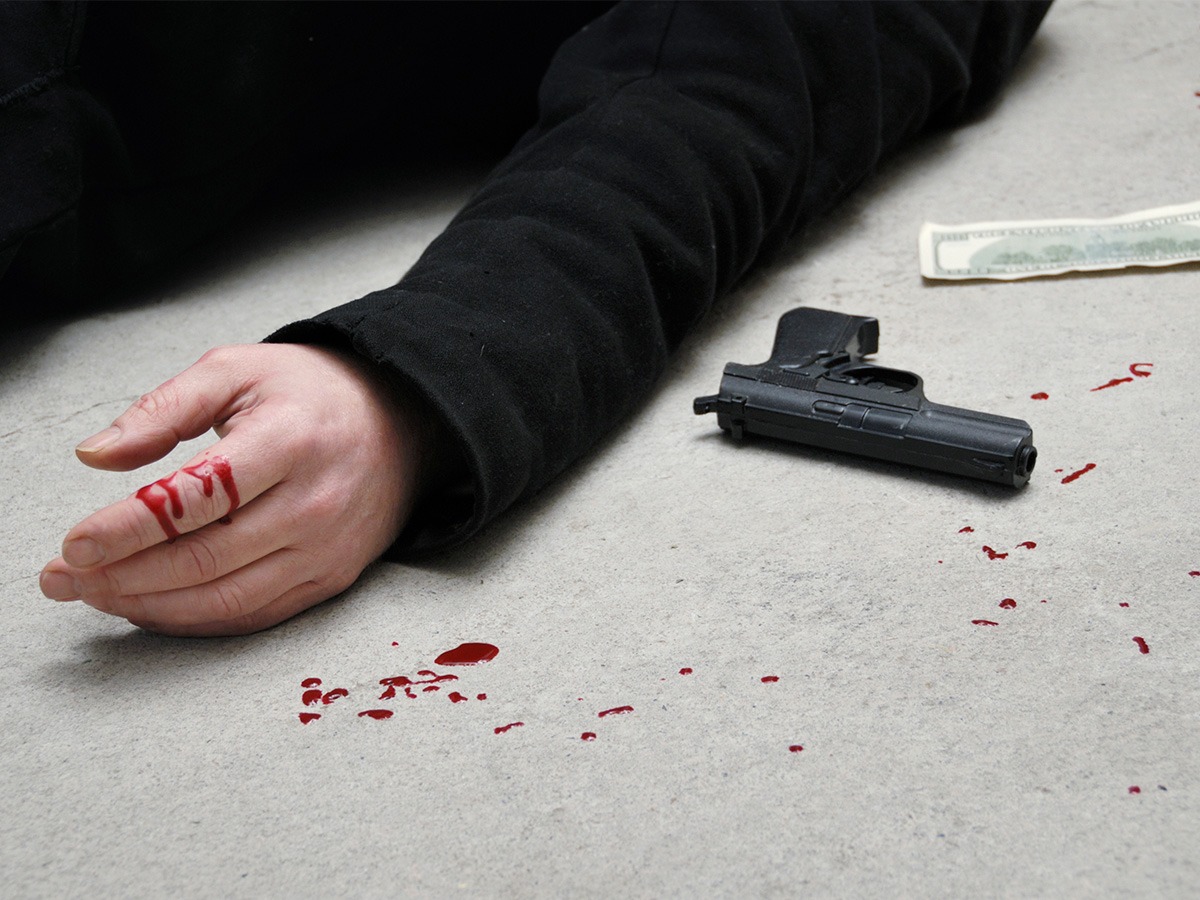
The fight doesn’t end with the last shot. Here’s what you need to do in the moments after a defensive shooting.
Most of the conversation in the concealed carry world centers on the fight itself: draw speed, shot placement, threat assessment and the mechanics of stopping a threat. That’s essential training, and none of it should be shortchanged. Nevertheless, there’s another aspect that doesn’t get nearly enough attention:
What happens in the minutes after the shooting stops, before the first squad car rolls onto the scene?
The gap between the last shot fired and the moment a badge walks through the door can get you killed, not by the bad guy, but by a responding officer who doesn’t know yet that you’re the good guy.
The Arvada, Colorado, incident illustrates this with brutal clarity.
A deranged gunman with a vendetta against law enforcement showed up at a shopping center and ambushed an Arvada police officer, killing him. Other officers nearby failed to engage. A Good Samaritan named John Hurley ran toward the threat, engaged the gunman and stopped him. Five of six rounds connected. The attacker went down.
By any measure, Hurley did everything right in the fight. Then, things went wrong.
After neutralizing the shooter, Hurley moved to the downed attacker and began trying to unload the man’s AR-15. He still had his own pistol in his hand while he struggled with the unfamiliar rifle. That’s when a responding officer emerged and shot Hurley from behind without warning or verbal commands. Hurley died from his wounds.
The district attorney declined to prosecute the officer, citing the fog of war. A civil complaint later alleged that the officer had observed Hurley for nearly 10 seconds before pulling the trigger and still could not distinguish the good guy from the bad guy.
That story should be burned into the mind of every armed citizen in America as a reminder that surviving the critical incident is not the finish line. You still have to survive the aftermath.
The Physiological Reality
When a fight happens, your body does things you cannot fully control. Your vision narrows. Your hearing shuts down. Your fine motor skills deteriorate. Your heart rate spikes. Time warps. Memory becomes unreliable. These are well-documented stress responses, and they hit trained police officers just as hard as they hit non-police.
Those same officers are rolling to the scene of a shooting flooded with adrenaline. They don’t know how many shooters there were, which one is alive or which one called 9-1-1. They’re seeing a person with a gun, and that person needs to immediately and unmistakably communicate that they are not the threat.
You cannot assume the cops know you’re the good guy. You have to prove it quickly through every signal available to you.
Holster the Gun
If there is one non-negotiable rule for the aftermath, it is this: The moment the threat is stopped and the scene is reasonably safe, holster your firearm or drop your firearm upon police arrival.
A skilled shooter with a 1.5-second draw can afford to be holstered. The gun is not gone. It’s accessible, but a holstered gun tells every armed person arriving on scene a critical story. It says, “I am not actively engaged in a threat. I am waiting. I am not a danger to you.”
Hurley’s pistol was still out when the officer shot him. That detail likely cost him his life.
Don’t touch the bad guy’s gun unless you have a specific, urgent reason—such as another threat reaching for it or a situation that forces you to move. Otherwise, leave it. A responding officer or bystander seeing you handle a rifle at a shooting scene will not think “concerned citizen;” they will think something far more dangerous.
Find a Better Position
After holstering, assess your position. Standing over a downed attacker with a gun in your hand is about the worst possible perspective you can present to someone who just drove 80 miles an hour to a shooting call. Move away and find a position that gives you a wider angle on the scene, keeps you visible, puts some distance between you and the attacker and ideally places you near cover.
You’re not fleeing. You’re repositioning to survive the next phase. There’s a meaningful difference, and it matters legally and tactically.
Build the Welcoming Committee
Firearms instructor Massad Ayoob teaches a concept he calls “the three rings of safety,” and it deserves serious consideration. Think of it as concentric circles radiating out from you.
The outermost ring is the 9-1-1 call itself. That call starts the information pipeline. Describe yourself precisely: name, age, build, clothing, etc. Use identifying details that won’t change: “I’m in my 50s, black T-shirt, jeans, hands visible on my white truck.” Clearly establish you were the one who called, that you defended yourself, and you need police and EMS.
The middle ring is what Ayoob calls the welcoming committee. If there is a trusted person near you, such as a spouse, a friend or a store manager, send them to the perimeter to intercept the responding officers before they reach the scene. This person’s job is to repeat your description, confirm who the good guy is and help bring down the officers’ anxiety before they walk into an ambiguous situation. They need to be completely nonthreatening in posture and movement, and they need to know exactly what to say.
The inner ring is you. Your hands should be visible, and your firearm should be holstered or on the ground. You should display a compliant posture. You are going to let those officers control the scene. You may be knocked to the ground. You may be handcuffed and treated roughly. You should expect that. Let them sort it out. Your goal in the inner ring is to stay alive long enough for the truth to surface.
The Halo Effect
There is a cognitive trap that kills good people in these situations. It’s the tendency to think, I know I’m the good guy, so everyone else must see it, too. This is not how it works. Officers rolling onto a shooting scene see a person with a gun standing over a body. That is all they see.
Shake off the halo effect. You are not automatically identifiable as the defender. You have to make them understand that—carefully, without sudden movements and without anything that could be misread as hostility.
Visualize Before You Need It
None of this works if you’re encountering these ideas for the first time when a gun is in your hand and someone is bleeding on the pavement. The time to work through these scenarios is now, sitting at your kitchen table or watching dashcam footage of real incidents. Visualize potential scenarios and think through where you would move, what you would say on the call, and who in your life could serve as a welcoming committee.
The goal is simple: When the worst happens, you don’t want to be the person who says, “This is surreal.” You want to be the person who says, “I knew this could happen, and I know exactly what to do.”
Editor’s Note: This article originally appeared in the July 2026 issue of Gun Digest the Magazine.
More Knowledge For The Armed Citizen
Read the full article here