

As Mark Thornton has detailed in his brilliant book, The Skyscraper Curse, Austrian School economists’ unique theory of the business cycle has given them a distinct advantage in foreseeing oncoming economic crises: from Ludwig von Mises’s 1920s predictions of looming bank failures, to Thornton’s own 2004 warnings of the housing bubble and its consequences. Contemporary Austrians continue to apply this theory when scrutinizing the anxious landscape of today’s economy, looking for early warning signs of where central bank monetary manipulation will manifest itself next.
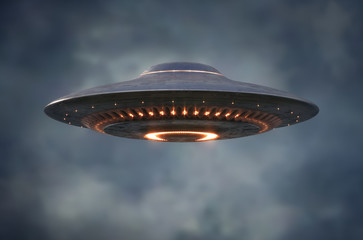
However, depending on the course which history takes, we may someday look back and reflect that today’s Austrians were outdone in their prognostications by one Helen McCaw, who has recently warned that the next financial crisis could be triggered by the announcement of the existence of extraterrestrial life.
Ms. McCaw—a former senior analyst at the Bank of England—wrote to the current governor of Britain’s central bank to warn that a supposedly imminent announcement of the existence of advanced alien life might cause extreme uncertainty in financial markets, possibly triggering bank collapses. “The United States government appears to be partway through a multi-year process to declassify and disclose information on the existence of a technologically advanced non-human intelligence responsible for Unidentified Anomalous Phenomena [the official name for UFOs].” McCaw argued that an announcement of the existence of “a power or intelligence greater than any government and with unknown intentions” could “induce ontological shock and provoke psychological responses with material consequences… There might be extreme price volatility in financial markets due to catastrophising or euphoria.”
Whether or not this announcement is as imminent as McCaw expects, it is doubtless true that such an encounter would provoke a certain amount of emotion amongst the human inhabitants of the Earth, and this would likely result in some economic volatility. However, beneath the surface of this least esoteric aspect of McCaw’s warning, some readers might have noted the faint echoes of a long-running clash of economic ideas. McCaw’s focus on “catastrophising or euphoria” reflects John Maynard Keynes’s famous view that the see-sawing emotions or “animal spirits” of investors are amongst the most significant drivers of the business cycle. While this perspective strikes many as intuitive and straightforward, placing the blame for the business cycle on the chaotic and inscrutable emotions of the rentier class lacks the explanatory power of the Austrian business cycle theory. This latter theory—pioneered by Mises and F.A. Hayek—identifies the creation of fiduciary media (i.e., artificial credit) by banks, and the consequent artificial lowering of interest rates, as the key driver of manic “booms” of malinvestments. However, these factors also cause inflation and outflows of bank reserves, which eventually force interest rates back upwards again. Once this happens, businesses must reevaluate and liquidate many projects that had only seemed profitable due to the unsustainably low interest rates during the speculative mania. This painful reallocation of resources constitutes the “bust” phase of the boom-bust cycle. Ironically, McCaw’s implicit emphasis on the animal spirits that would be unleashed by our discovery of alien life (or their discovery of us) tends to confirm Keynes’s famous dictum that we are all “slaves of some defunct economist” in our ideas, whether we realize it or not.
This debate is also reminiscent of a famous previous case of speculation about the possible economic impacts of extraterrestrial life. In 2011, during the long and troubled recovery from the Great Recession, the Nobel Prize-winning Keynesian economist Paul Krugman infamously argued that the government could quickly fix the economy by faking an alien invasion, and thereby justifying fiscal and monetary stimulus in the name of anti-E.T. defense spending. (Strictly speaking, Krugman merely said that a widespread mistaken belief in an alien invasion would be necessary to produce this benevolent outcome, although the idea that such an invasion could be faked by the government was arguably implicit in the context of his remarks). This argument could be seen as a futuristic rephrasing of Keynes’s own suggestion that the government could improve the economy by simply burying banknotes under piles of rubbish, and encouraging individuals to dig them up again (per Keynes). In both cases, the essential point was that government spending—even toward totally pointless ends—would at least have the effect of providing previously-unemployed workers with money to spend, and thereby boosting living standards across the whole economy through the benign influence of the Keynesian multiplier.
However, as economists of the Austrian School have often pointed out, arguments of this kind are examples of the notorious broken-window fallacy. This fallacy was most brilliantly dissected in a 1850 parable by the French economist Frédéric Bastiat, who imagined a crowd of spectators cheering on a hooligan for breaking a shop window; after all, hasn’t his crime boosted the economy by providing work for the glazier? The crowd’s perspective is fallacious because it recognizes the “seen” consequence of the glazier’s enrichment, while neglecting the “unseen” consequence that the shopkeeper would otherwise have put that money toward some other, more highly-valued end. Government spending—whether for defense from an alien invasion or for any other purpose—likewise necessarily diverts resources away from the ends which individuals would otherwise have chosen themselves, based on their most urgently-felt needs.
Economists of the Austrian School have used this insight to reevaluate many arguments that are often treated as gospel truths by pro-interventionists. For example, Robert Higgs has convincingly demonstrated that US government spending during the Second World War—far from having finally ended the Great Depression—actually delayed the recovery by directing huge quantities of resources toward the war effort and away from private sector endeavors to satisfy the true desires of consumers.
Therefore, if Helen McCaw is correct to predict that the existence of advanced alien life will soon be revealed to the human race, the best we can hope is that the representatives of the world’s governments somehow remain oblivious to this fact. After all, if given a choice between invasion from beyond the stars or the Earth First efforts of our own terrestrial leaders, the least-worst option may not become apparent until the human race has asked itself some deep and probing questions.
Read the full article here