

More than 80 years separate B-29s dropping the atomic bombs on Japan and the P-51 providing revolutionary long-range escorts for Allied bombers over the skies of Germany. In an age of drones and unmanned aircraft, crewed aircraft almost carry the patina of the past.
Yet, the Smithsonian’s National Air and Space Museum’s latest gallery, “Modern Military Aviation,” emphasizes that “everything in here was designed by people making choices,” Michael Hankins, curator of U.S. Air Force, Navy, and Marine Corps post-World War II Aviation, told Military Times.
“I hope that people can start to see what some of those choices were, why some were made or not made, and how these things evolved over time through the lens of the people behind them.”
The exhibit, opening on Nov. 11, showcases over 150 aviation artifacts from the post-WWII era through the present day. The gallery, according to Hankins, helps to connect America’s geopolitical force posture “and what it means for the United States to be interacting globally in this way, and how it uses these technologies to get there.”
We’re covering almost 80 years of history in this room, which is a challenge to do,” Hankins said.
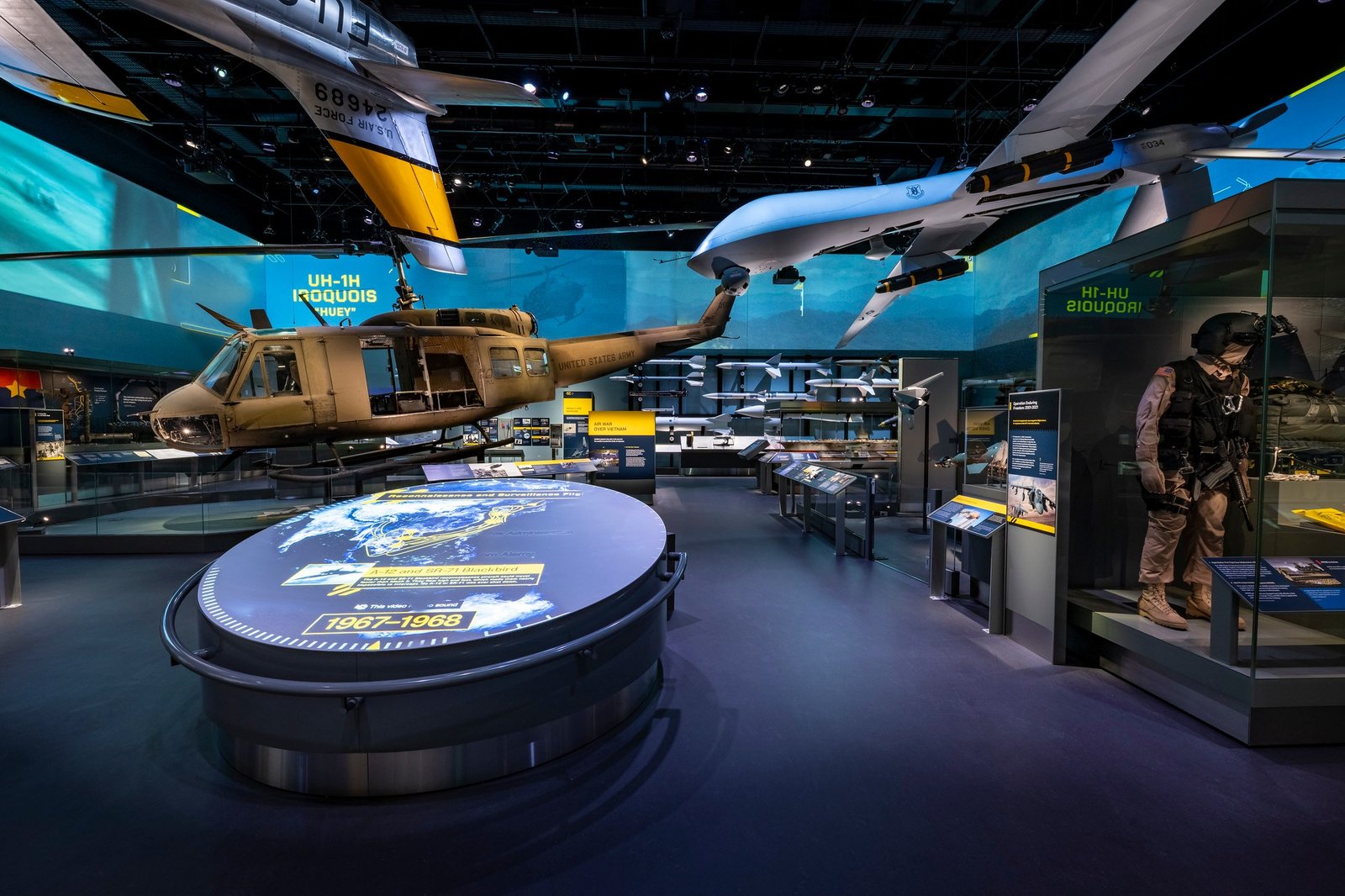
Among those objects and aircraft showcased in the exhibit is an MQ-1 Predator drone, which was one of the three that were weaponized and sent into combat operations in Afghanistan shortly after the 9/11 attacks.
Poignantly, situated almost directly below the drone is a fragment from one of the two commercial airliners that were hijacked and crashed into the World Trade Center towers on Sept. 11, 2001.
“We really felt strongly that we should include it because it’s hard to think of a more historically significant event, certainly of my lifetime and many of our visitors’ lifetimes, but something that really changed world history in a significant way,” said Hankins.
“There are a lot of unique preservation concerns because, you know, it looks somewhat distressed, as you can imagine, and there’s a lot of damage to the metal in there,” he continued. “So we have to put effort into maintaining it, keeping it from degrading further, but also not changing it too much. Our conservation department does a really marvelous job of doing all of that stuff. These are people that have advanced knowledge of chemistry and metalworking and engineering, and they’re able to do that kind of work and preserve these artifacts for generations.”
Among other objects, including a UH-1H Huey that saw multiple tours of combat in Vietnam, is the specific Hycon B camera that directly contributed to the Cuban Missile Crisis. Carried by a Lockheed U-2 aircraft, this camera was responsible for capturing “definitive images of Soviet nuclear missile sites,” according to the museum. Visitors can then scan through the images taken by the camera that led the world to the brink of nuclear war.
Hankins emphasized not only the aviation technologies, but how they reshaped modern warfare and America’s response to threats — and diplomacy.
“There’s a lot of material in here that we talk about, and I think there’s a lot of ideas and a lot of history here,” said Hankins. “But if there’s a core idea to it, it’s that America’s kind of place as a global superpower is in large part enabled through the technologies you’re going to see here. The aviation technology that was developed over those 80 years is what lets America project power globally across the world.”
Read the full article here