

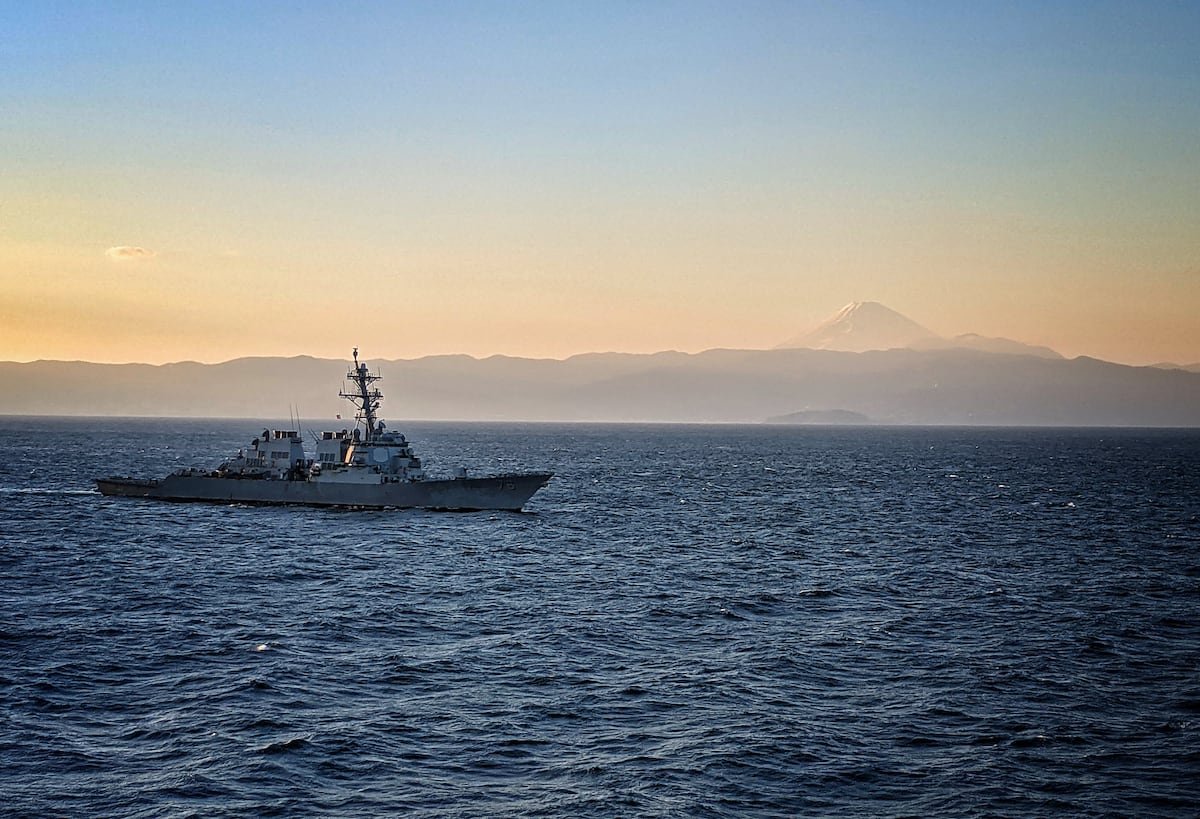
An “engineering casualty” broke out on Tuesday on the USS Higgins, an Arleigh Burke-class guided-missile destroyer currently deployed in the Indo-Pacific, Navy officials confirmed to CNN.
The incident was immediately contained by the crew, and there are no reported injuries as of Friday, according to the Navy statement.
While the Navy did not explicitly use the term fire, CBS News, citing unnamed U.S. officials on Thursday, described the situation as a fire limited to one piece of equipment that did not spread flames.
However, the incident knocked out the ship’s electricity and propulsion for “several hours,” according to the CNN report. The outage rendered the 300 sailors aboard the Higgins essentially sitting ducks as they were unable to control the destroyer’s movements for a time.
“Initial reports indicate an electrical malfunction, which may have produced sparking or smoke that ceased once power was removed,” Cmdr. Matthew Comer, a spokesperson for the U.S. 7th Fleet, said in the statement to CNN on Friday.
Power and propulsion have since been restored aboard the Arleigh Burke-class destroyer, Comer said.
This is the fourth fire in as many weeks that have disrupted the fleet.
On April 19, three sailors were injured when a fire broke out on the USS Zumwalt as it was stationed pierside at a Pascagoula, Mississippi, shipyard. The USS Dwight D. Eisenhower sustained a small fire on April 14 while it was sidelined for maintenance.
In March, a blaze that broke out in the USS Gerald R. Ford’s laundry room forced the aircraft carrier to port in Crete after the fire displaced nearly 600 sailors from their beds.
The Navy did not specify the exact location of the USS Higgins when the electrical malfunction occurred, saying only the ship was at sea in the Indo-Pacific Command’s area of responsibility.
Details regarding how the fire started and the extent of the damage is currently unavailable, with a Defense Department official noting to CBS that the cause is currently “under investigation.”
Requests for comment from CHINFO and 7th Fleet were not returned as of publication.
Named after Col. William Higgins, a Marine Corps veteran of the Vietnam War who was later captured in Feb. 1988 and subsequently tortured and killed by Hezbollah-linked militants, the USS Higgins was commissioned in 1999 and is part of the more than 70 Arleigh Burke-class destroyers within the U.S. Navy’s surface fleet.
Known as the “backbone” of the surface fleet, the ship’s combat capabilities center around the Navy’s Aegis Weapon System and is the longest, most successful surface combatant program in U.S. Navy history, according to General Dynamics.
The USS Higgins is homeported in Yokosuka, Japan, as part of the Navy’s 7th Fleet — its largest forward-deployed fleet operating 50 to 70 ships and submarines, 150 aircraft and more than 27,000 sailors and Marines at any given time.
Claire Barrett is an editor and military history correspondent for Military Times. She is also a World War II researcher with an unparalleled affinity for Sir Winston Churchill and Michigan football.
Read the full article here