

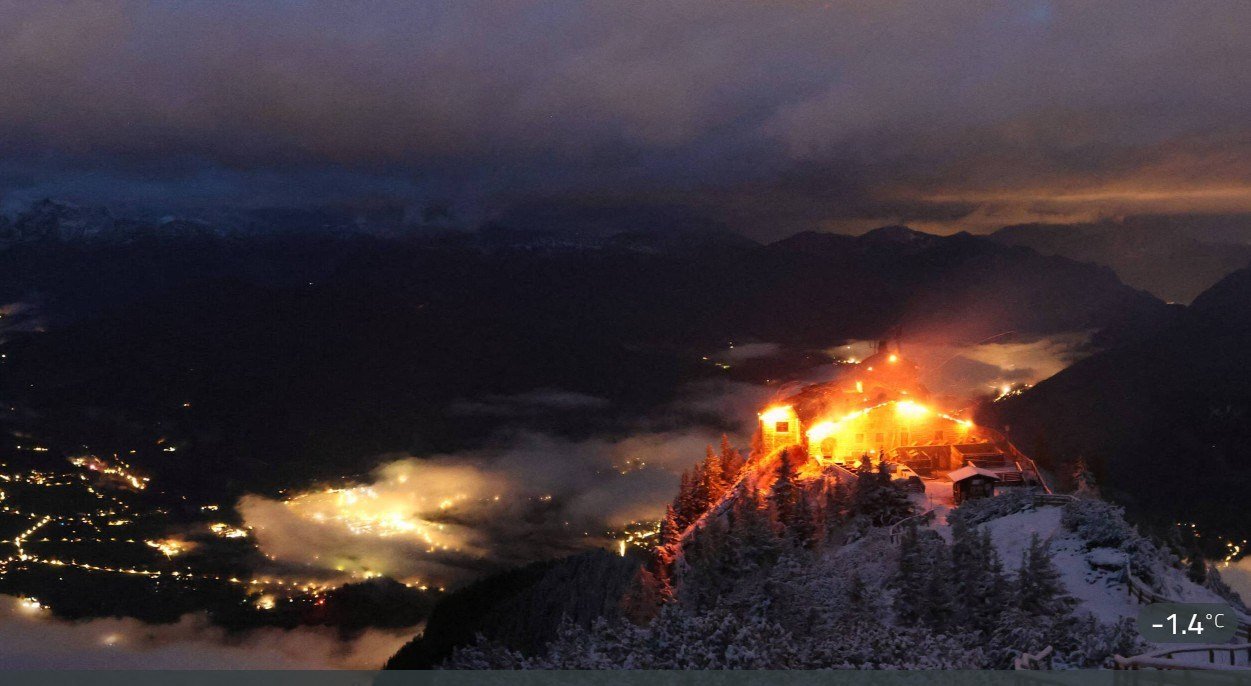
A 33-year-old German citizen was arrested over the weekend after a fire tore through one of the last architectural relics of Nazism.
On Friday, roughly 200 firefighters were deployed to Adolf Hitler’s notorious Bavarian retreat, dubbed the “Eagle’s Nest,” shortly after a smoke detector triggered an alarm around 9:15 p.m. local time.
Surrounded by rough mountainous terrain near the Austrian border, the infamous retreat is accessible only by a single road and a series of tunnels that lead to the base of the knoll. The historic building sits at an altitude of roughly 6,000 feet, hampering efforts to put out the blaze.
By 9:52 p.m., when firefighters arrived on the scene, the entire structure was engulfed in flames and deemed largely unsalvageable.
No one was hurt, authorities said, and their investigation into what appears to have been a deliberately set fire is ongoing.
Carved into an Alpine crag, the structure, designed by Martin Bormann, head of the Nazi Party Chancellery and Hitler’s private secretary, was intended to serve as a diplomatic reception venue rather than an operational command center. It did not, according to The Telegraph, host any of the regime’s fateful conferences, which all took place lower down at the Berghof.
“This was because the supposedly fearless Alpine Führer was really a hypochondriac crippled by acrophobia who complained the thin air at the Eagle’s Nest aggravated his stomach spasms. He was also terrified of lightning striking the complex’s lift mechanism,” writes the outlet.
Hitler himself only visited the site a handful of times.
The building, however, also holds unique lore for one unit of Army paratroopers — made famous by Stephen Ambrose’s 1992 bestseller Band of Brothers and the subsequent 2001 HBO miniseries of the same title.
In 1945, the Allied Command feared the Germans were planning a “last stand” in Berchtesgaden and, to that end, Gen. Eisenhower ordered it to be secured before German resistance could coalesce around the Nazi stronghold.
On the morning of May 5, the hard-bitten 506th Parachute Infantry Regiment of the 101st Airborne Division, which had fought near-continuously from D-Day through Operation Market Garden and the Battle of the Bulge, arrived in Berchtesgaden. While they weren’t the first — the 7th Infantry Regiment of the U.S. 3rd Infantry Division and the French 2nd Armored Division hold that distinction — they stayed the longest, culminating in some iconic photos from the end of the war — particularly that of a heavily hungover Capt. Lewis Nixon after he and his men drank their way through Hitler and Hermann Goering’s booze collection.
The structure was spared from the wrath of Allied bombing and postwar, and while plans to dynamite the Eagle’s Nest — and all remaining Nazi structures — were created, the notorious guesthouse was spared from destruction on the intervention of the district administrator, Karl Theodor Jacob.
Jacob proposed to neutralize Nazi tourism through “profanation” — namely beer.
“I always said, let’s serve Munich Hofbräu beer up there,” Jacob later recalled, “and then no reverent mood will ever take hold.”
Now, the alleged arsonist has destroyed what the Allies and postwar Germans did not.
“It is damaged to a large extent,” a police spokesperson told the German tabloid Bild. “The house is unlikely to be saved.”
Read the full article here