

For more than two decades, American forward operating bases across the Middle East appeared all but untouchable, bastions of U.S. military might where troops often strolled openly, sans body armor and devoid of concern about an enemy lurking beyond guarded gates.
Exorbitant damage brought on by a deluge of Iranian drones and missiles in the wake of the Feb. 28 launch of Operation Epic Fury has — expeditiously — rendered those installations anything but.
Damage estimates have since ballooned, vulnerable assets forced to relocate and families evacuated from longtime regional hubs such as NSA Bahrain left in limbo, with Chief of Naval Operations Adm. Daryl Caudle telling sailors as recently as Aug. 31, “We’re not getting back in there any time soon.”
In all, the U.S. military has spent more than $47 billion on the war, according to a recent Pentagon estimate. That sum included $6 billion to replace military equipment and more than $29 billion to replenish costly munitions. The U.S. Navy’s ongoing naval blockade in the Strait of Hormuz — and the fuel, munitions and supplies to support it — will only push that number higher. In the U.S., impacts of the conflict are estimated to have cost an average of $2,000 per household.
Any fiscal damage pales next to the 23 U.S. dead and 866 wounded since Feb. 28. Two more U.S. airmen died last week in “non-hostile” incidents.
And still yet to be released are the Pentagon’s findings into the Feb. 28 missile strike on the Minab School in Iran, a shocking miscalculation that killed over 150 people, approximately 120 of them children. Bloomberg on Oct. 15 reported that the Pentagon planned to hold its internal investigation until after midterms, despite various independent investigations already pointing to U.S. involvement in the strike.
Taken together, public perception of the campaign has become such that on Wednesday, U.S. Vice President JD Vance openly blamed the war for what became a historic midterm annihilation suffered by the Republican Party.
“The reason we lost is the war,” Vance wrote in a lengthy social media post after Democrats took control of the U.S. House and Senate. “If you’d like to argue it was worth it, that losing the Senate for the next 6 years was worth it, then do so. But everyone knows why we lost.”
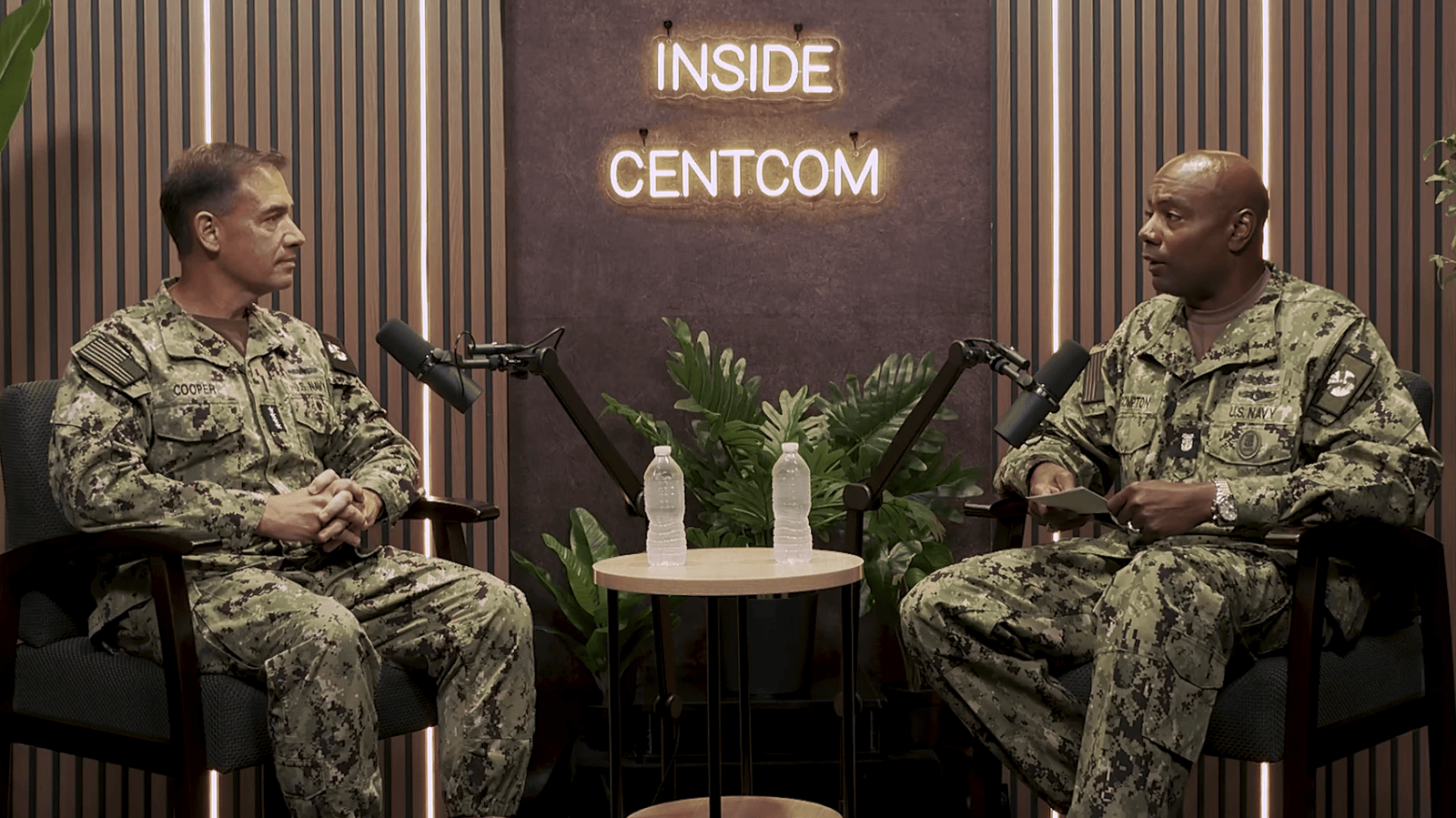
It is against this backdrop that one of the architects of the Iran war strategy, U.S. Central Command chief Adm. Brad Cooper, appeared as the first-ever guest on “Inside CENTCOM,” a lifestyle podcast that debuted Thursday brimming with such vital discussion topics as Cooper’s proclivity for french fries, basketball free-throw shooting and sun-soaked beaches.
In a nation already under siege by an average of one military or veteran podcast for every five human ears, what’s one more?
“I’ll be asking the questions you want to know,” Fleet Master Chief Lateef Compton, CENTCOM’s senior enlisted leader, states on a set replete with a neon sign bearing the pod name.
“You like french fries. Most people don’t know this, but … when we were stationed together years ago, my lunch would come, and I would always have french fries,” Compton recalled. “You would see my french fries … and you would at least take one or two. … I don’t think you ever knew that I knew you took my french fries. Is that your favorite food? French Fries.”
“We should let the world know: For years, I’ve been eating your french fries,” Cooper responds. “The secret is now out. I never met a french fry I didn’t like.”
The duo tackled additional topics like the importance of daily workouts, memories of service on past ships, an affinity for San Francisco 49ers legend Jerry Rice, playing basketball while at sea and the virtues of exercising patience.
Sailors currently exercising patience, meanwhile, are those aboard the Arleigh-Burke class destroyer USS Spruance, which recently set a post-World War II record for a U.S. Navy destroyer deployment. As of Nov. 5, Spruance and its crew have been deployed for 349 days. The warship does not yet have a definitive return date.
“We are hearing they’re supposed to come home sometime next month,” Marie Bailey, whose husband serves aboard Spruance, told Military Times. “But we’ve been hearing about ‘next month’ for several months.”
Also exercising patience are sailors aboard the deployed destroyers USS John Finn, USS Mustin and USS Rafael Peralta, each of which had expected return dates pushed from 2026 into 2027, with some expected to stretch over 14 months, according to Defense One.
“There’s [deployed sailors’] cars that were left on base that have been stickered to be towed and then to be junked,” a spouse of a John Finn sailor told the outlet. “So there’s sailors that are going to come back and have no cars.”
These record-setting deployments continue in the wake of the aircraft carrier USS Abraham Lincoln’s return, which arrived home on Oct. 8 after a 322-day deployment that raised concerns over deteriorating mental health, with multiple sailors reportedly attempting to jump overboard at sea.
Recently reunited Lincoln families are exercising further patience while navigating a permanent change of station, with the hulking vessel changing its home port from San Diego to Naval Base Kitsap-Bremerton, Washington.
While long planned, the extended deployment left many family members in limbo and scrambling to get affairs in order once a return date was finally set.
Despite myriad concerns among sailors and families about extended deployments and a strained operational tempo, questions regarding the above did not make it into the show.
Read the full article here