
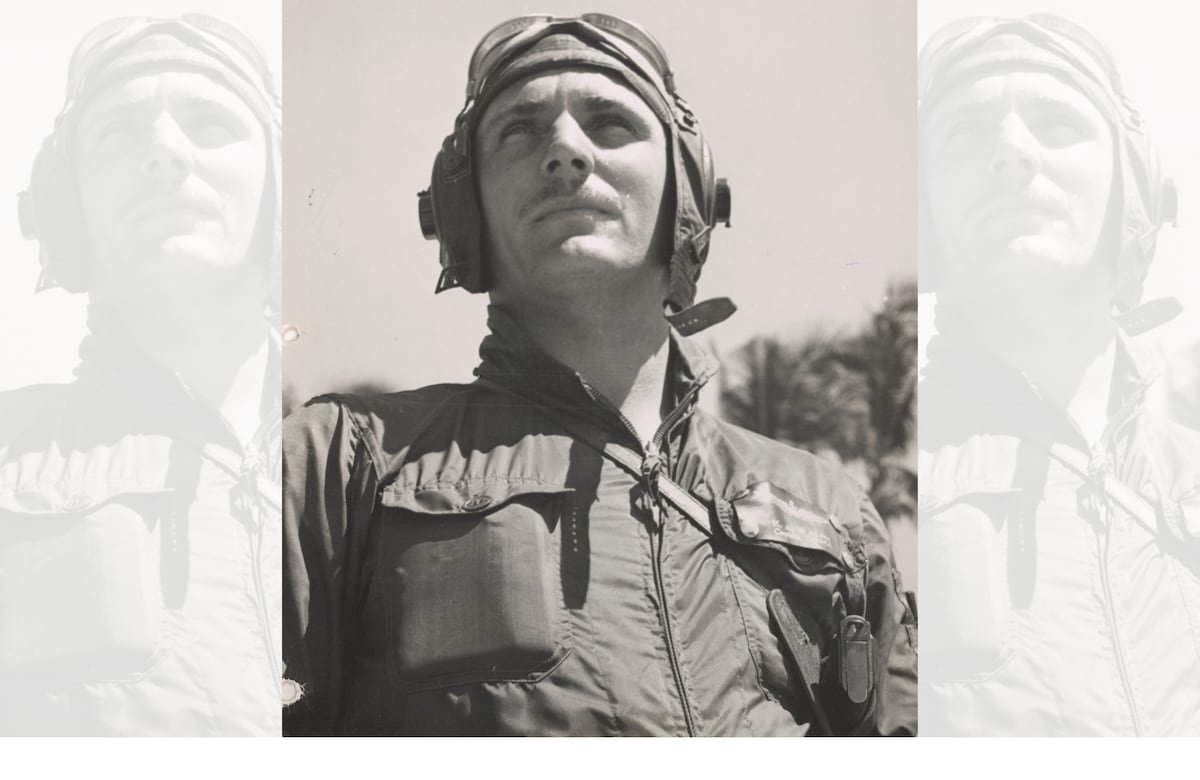
World War II in the Pacific produced a remarkable 10 fighter pilots of the United States Marine Corps who were awarded the Medal of Honor. Aside from Captain Henry T. Elrod at Wake Island, they all earned them in or around the Solomon Islands. Among them was the first to achieve ace status in a new entry to the USMC arsenal, one with which his name would be associated: Kenneth Walsh and the Vought F4U-1 Corsair.
Born in Brooklyn, New York, on Nov. 24, 1916, Walsh joined the Marines as a private in 1933, serving as an aircraft mechanic and a signalman. But Walsh wanted to be in the air, not just fixing the planes, and in 1937 Walsh earned his wings and spent the next few years serving on aircraft carriers, according to the DOD.
When war broke out in December 1941 Walsh was stationed with VMF-121 at New Bern, North Carolina, but by January 1943 Walsh was sent to the South Pacific with VMF-124 — the first operational Marine squadron to fly the F4U Corsair, although the Navy had introduced it earlier to its own fighter outfit, VF-17.
The F4U Corsair was the first single-engine fighter to exceed 400 mph and, despite a rocky start (the Corsair’s carrier takeoff and landing characteristics had been disappointing), became one of the most capable carrier-based fighter-bombers of the war.
Walsh’s first frontline flight was less than auspicious: during a test flight on Feb. 1, he crash landed his Corsair. Nevertheless, its overall characteristics convinced the Marines that for once their latest Navy hand-me-down had the potential for a winner.
Walsh and his fellow pilots worked out tactics to make the most of its performance and ruggedness while avoiding dogfighting with the Zero.
On April 1 he put his concepts to impressive practice when he shot down two A6Ms and an Aichi D3A “Val” dive bomber.
On May 13 he downed three Zeros and damaged a fourth east of the Russell Islands to become the first Corsair ace and subsequently was promoted to first lieutenant on May 31. The following month he added another Zero and a Mitsubishi F1M2 floatplane to his score over Bougainville.
But August was to be a month of violent ups and downs for Walsh.
On the 12th he and 15 squadron mates were escorting Consolidated B-24 bombers when they encountered a swarm of Japanese Zeros over Choiseul Island near the Solomon archipelago.
VMF-124 claimed three of the fighters, two of which were credited to Walsh (in actuality the Japanese lost only one), but in turn a Zero shot up his hydraulics, forcing him to land “hot” at Segi Point with gear and flaps retracted, crashing into another Corsair on the airfield.
Undaunted, he was back in the air on the 15th, providing cover for the Allied landing at Vella Lavella, destroying two Vals off the north coast and a Zero north of Cracker Base. On the 21st he downed a Zero near Baga Island. The 23rd saw him probably shoot down a Zero northwest of Vella Lavella, followed by two Zeros confirmed in the Munda area.
On August 30 VMF-124 rose from Barakoma Airfield to escort B-24s bombing Buin on southern Bougainville. In the course of the day’s missions Walsh suffered engine trouble, but he quickly landed at Munda, apportioned another Corsair and flew to rejoin his formation over Kahili.
He was still separated from his escort when, alone, Walsh encountered roughly 50 Zeros over the objective. Walsh “unhesitatingly attacked,” according to his Medal of Honor citation, “striking with relentless fury in his lone battle against a powerful force. He destroyed four hostile fighters before cannon shellfire forced him to make a dead-stick landing off Vella Lavella.”
He was subsequently picked up by Navy Seabees who had watched his Corsair crash into the sea.
On Sept. 7, 1943, VMF-124 was called home after three combat tours, in which Ken Walsh had earned four Distinguished Flying Crosses, two Air Medals and seven strike/flight Air Medals.
Back in the United States, on Feb.8, 1944, Walsh, already the first Corsair to become an ace, also became the first Corsair pilot awarded the Medal of Honor when President Franklin D. Roosevelt pinned it on him for his tackling of the odds on August 15 and 30, 1943. On the same day, he was promoted to captain.
Walsh’s war was not quite over, however.
After instructing at Jacksonville, Florida, the Marine pilot returned to combat with VMF-222, flying fighter bomber missions from Samar, Philippines, from April to June 1945, and from newly secured Okinawa from June to the end of the war.
Continuing his Marine career, Walsh flew transports for VMR-152 in Korea, from 1950 to 1951, was promoted to major in April 1952 and to lieutenant colonel in October 1958. He retired from the Corps on Feb. 1, 1962.
Walsh continued to work with veterans’ groups and remained active with the men he fought alongside. According to the DOD, an article in the 1994 Orange County Register, Walsh also sought out several Japanese pilots, some who may have even shot him down.
“There is a camaraderie among pilots,” he told the newspaper. “You respect the skills of the other guy. Most have a code of ethics. I would never strafe a downed pilot. Most of them wouldn’t, either.”
Walsh died from an apparent heart attack on July 30, 1998, as he prepared to depart his hometown of Santa Ana, California, for the National Fly-In at Oshkosh, Wisconsin. He is buried Arlington National Cemetery.
Read the full article here