

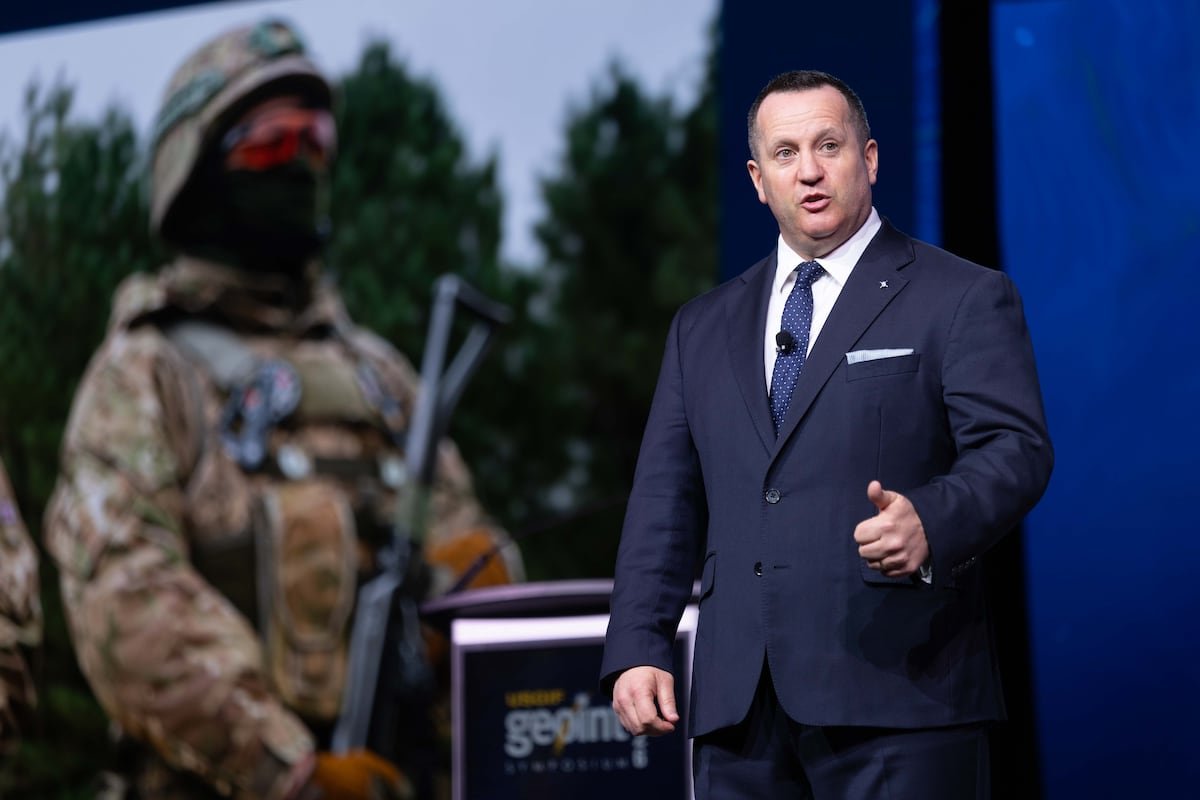
Aurora, Colo. — An increasingly contested global order is pushing demand for commercially-generated intelligence, but NATO needs to replace outdated policies to share that intelligence quickly and without barriers, said Maj. Gen. Paul Lynch, a British Royal Marine and NATO leader.
Currently, the 32 countries that make up the alliance share commercial data through exceptions and workarounds, said Lynch, NATO deputy assistant secretary general for intelligence.
NATO needs new data-use policies, security classification guides, contract frameworks and releasability rules — “unglamorous work” that would have a big impact on military decision-making, he said.
“This past year has made one thing crystal clear: The security environment remains contested, and the advantage belong to those who combine unity of purpose with the speed of action,” Lynch said Monday at the annual GEOINT Symposium, hosted by the U.S. Geospatial Intelligence Foundation.
The symposium attracted companies, many of the U.S. military vendors, that among other things track Russian military activity in the Bering Strait, monitor China’s military exercises and last year provided the technology to determine the extent of the damage to Iranian nuclear facilities following Operation Midnight Hammer.
Lynch urged the intelligence professionals present Monday to help NATO update its framework for data-sharing.
Governing commercial intelligence becomes “significantly more complex” when it comes to data processed by artificial intelligence, he said.
“Then, it’s not simply asking who can share what, it’s asking whose model to use on what training data with what documented assumptions with what confidence threshold in what context,” Lynch said, adding that there needs to be one common AI model and interface to be used by commercial and national partners across NATO.
NATO has previously established hundreds of standardization agreements creating common standards for things like air defense, maritime awareness and data formats.
“NATO is quite good at governance,” Lynch said. “The question is whether we apply that same rigor to AI before the technology outpaces the frameworks or after, and the answer will be decided in the next few years.”
Last year, under pressure from President Donald Trump, European NATO members and Canada hit their goal of spending 2% of gross domestic product on defense. It marked a 20% increase in overall defense spending, Lynch said, and was the first time the members had met the goal since it was established in 2014.
At the NATO summit in The Hague last year, allies pledged to spend 5% of GDP on defense by 2035.
“Three years ago, that would’ve been considered science fiction,” Lynch said of the spending goal. “The alliance is now actively investing in its own security at a pace and scale we have not seen in a generation.”
However, investing in defense without also putting more money toward intelligence is “capability without awareness,” he said. “More is useless unless information generated gets to the right person in the right form at the right time.”
Nikki Wentling is a senior editor at Military Times. She’s reported on veterans and military communities for nearly a decade and has also covered technology, politics, health care and crime. Her work has earned multiple honors from the National Coalition for Homeless Veterans, the Arkansas Associated Press Managing Editors and others.
Read the full article here