
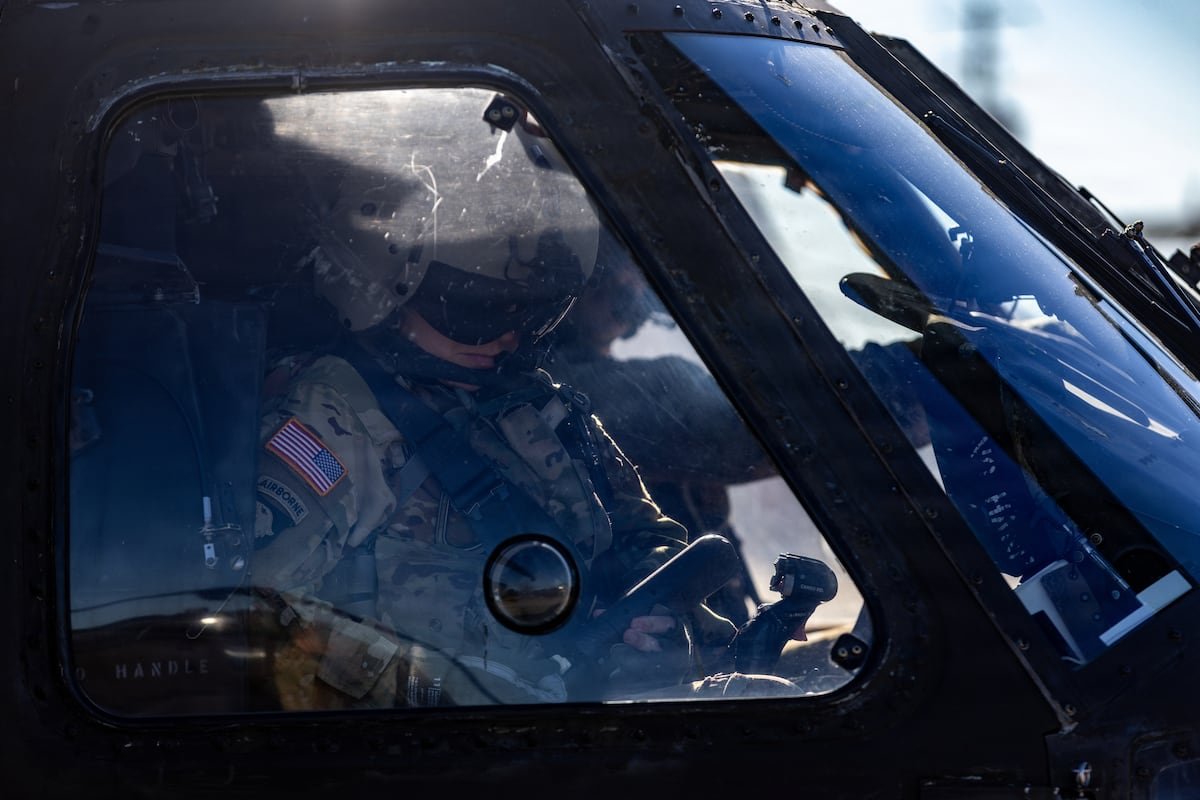
U.S. Army Helicopter pilots in the 101st Combat Aviation Brigade are evaluating a system designed to let them relieve themselves in flight. Soldiers will evaluate whether it can help address a problem pilots face during prolonged missions: limiting fluid intake to avoid restroom breaks.
The brigade completed the Army’s first-ever helicopter test flights using the Advanced Inflight Relief Universal System, or AIRUS, at Fort Campbell, Kentucky, from Oct. 5 to 7. The testing examined the system’s airworthiness for use on Army helicopters.
Aircrews from 1-101 Attack Battalion “No Mercy,” 6-101 Assault Helicopter Battalion “Eagle Assault” and 7-101 Heavy Lift Battalion “Eagle Lift” completed human-factors surveys, checked AIRUS for fit and tested its ability to let them relieve themselves in flight. The crews believe AIRUS will help them stay in the air longer.
The brigade’s Holistic Health and Fitness, or H2F, team sought out AIRION, the aerospace medical systems company that developed AIRUS, to help reduce the number of pilots purposefully dehydrating themselves to limit the need for restroom breaks during missions.
“We had pilots tell us they tactically dehydrate,” Capt. Gena Baisa, lead dietitian for the 101st CAB H2F team, said per an Army release. “So, we thought, how can we get a system specifically designed to allow them to use the bathroom in air so they can stay hydrated and optimize their performance?”
Chief Warrant Officer 2 Collin McAllister, an AH-64 Apache pilot who tested AIRUS, said the system differs from previous systems that used bags containing coagulant, according to an Army account of the testing.
“As we look to fight in contested environments where we will need to stay a lot longer to support the ground force, this could be a great contribution,” McAllister said in the account.
Representatives from Redstone Arsenal observed the test to provide recommendations on AIRUS’ flight suitability. A critical aspect of the evaluation involved assessing how aircrews with different body types could move while wearing the system.
“We tested AIRUS to see its airworthiness and started with egress testing,” said Elizabeth Rhonenus, a human-factors engineer with the Aviation Flight Test Directorate, in the release. “We took our smallest participant around the fifth percentile and our largest around the 95th percentile and saw if they could get in and out of the aircraft safely.”
The testing marked a developmental milestone, transitioning the system into the Army’s rotary-wing fleet, according to the Army. It was AIRION’s first time testing with the Army and its first time testing the system on helicopters, according to Colt Seman, the company’s founder and chief executive officer.
“We tested to get the system integrated into the Apache, Black Hawk, and Chinook helicopters,” Seman said per the release. “The pilots were able to put on AIRUS, wear it, and be able to use it. It was comfortable, and it worked.”
Baisa said the brigade is preparing for upcoming missions, including the Long Range Large Scale Air Assault concept and the new MV-75 Cheyenne II helicopters’ ability to stay in flight longer.
“We are setting the foundation now to support the upcoming missions our Soldiers will face,” Baisa said. “Looking at L2A2 and the new MV-75 Cheyenne II helicopters’ ability to stay in flight longer, we want to improve Soldier readiness. The AIRUS is a capability that could help us achieve it across the enterprise.”
Natalie Oliverio is an independent journalist and Navy veteran who covers military and veterans’ issues. Drawing on her experience as a talent executive and mentor, she writes about the policies, people and programs shaping the military community.
Read the full article here