

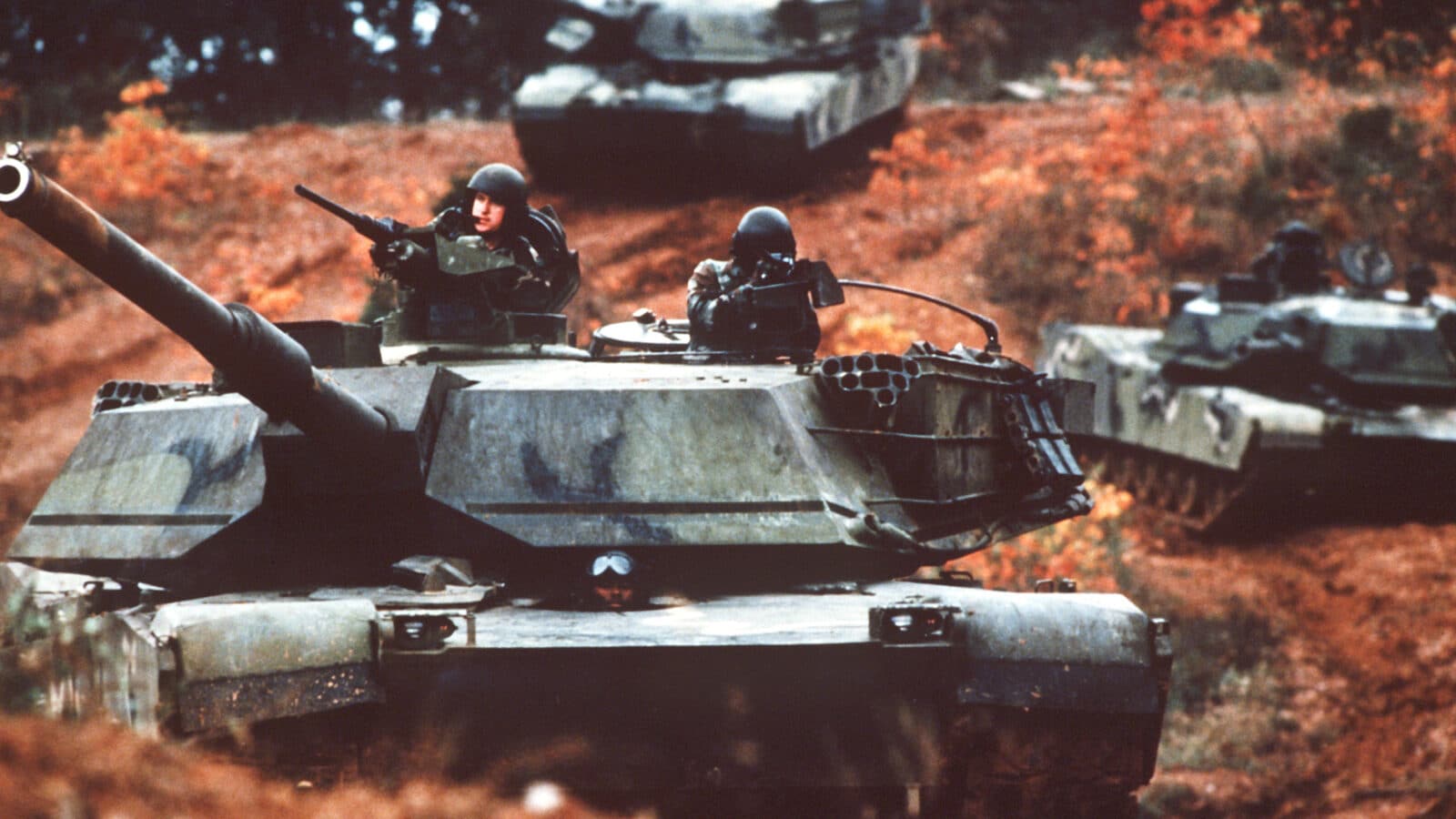
The M1 Abrams was conceived with a singular, unyielding purpose: the total destruction of enemy armored formations. Over the last four decades, it has become the absolute pinnacle of tank warfare made manifest. Its sheer battlefield dominance has not only won conflicts, but forced militaries across the globe to fundamentally rewrite their combat doctrines when it comes to both employing and defending against armored units.
From spearheading the rapid collapse of the Iraqi regime in the famous “Battle of 73 Easting” to maintaining overmatch and superiority in all manner of theaters worldwide, the Abrams has spent generations striking fear into the enemies of the Free World. As a tank crewman who has served on every position of the M1 Abrams in the U.S. Army, let me be the first to tell you: that fear is well-deserved.

While there have been many changes since the first 105mm M1 rolled off of the assembly line, its core identity remains exactly the same. Its familiar silhouette hasn’t changed much over the decades, but that familiarity should not be mistaken for stagnation. The current iteration, the M1A2 SEPv3, proves the platform’s enduring supremacy. Make no mistake: underneath that recognizable steel carapace lies a heavily upgraded, cutting-edge war machine that remains the pinnacle of armored technology, lethality, and protection available anywhere in the world.
Genesis & Evolution
Born from the ashes of a failed U.S./West German joint venture in the 1960’s, the United States eventually realized it needed its own independent, uncompromising design to hold the Fulda Gap against any Soviet incursions into the rest of Europe. The result of this realization was the M1 Abrams. Entering service in the 1980s with a 105mm rifled gun, it was a war machine purpose built for what is referred today as Large Scale Combat Operations (LSCO).

As the threat evolved, so did the Abrams. The first step of that evolution was the M1A1. This model introduced the much more powerful 120mm smoothbore cannon that is still used today. This power was demonstrated to the world firsthand during Operation Desert Storm.

Riding high off of the positive waves of absolute victory from Desert Storm, the M1A1 gave birth to the M1A2, which ushered in the digital age of armored warfare. Advanced fire control networks and independent thermal sights for both the tank commander and the gunner are now staples in the armored community, but they were cutting edge and game changing at the time.

During the Global War on Terror, the Abrams was forced to change its identity. Gone were the days of facing down enemy tank battalions. Now was the time of counterinsurgency (COIN) and urban warfare. Upgrade kits like the Tank Urban Survival Kit (TUSK) and System Enhancement Packages (SEP) facilitated that evolution and allowed the Abrams to adjust as needed to the mission at hand.

Live The Armory Life. The latest content straight to your inbox plus an automatic entry to each of our monthly gun giveaways!
However, times and missions have changed once again: COIN is out and LSCO is back in. The M1A2 SEPv3 showcases a definitive return to the Abrams original mission and purpose: complete domination over near-peer adversaries on the battlefield. Upgraded with enhanced power generation, an Ammo Data Link (ADL) with programmable munitions, and reinforced armor capable of defeating modern anti-tank guided missiles, the SEPv3 ensures the Abrams remains the apex predator in the conventional battle space.
Lethality and Firepower
The first thing any apex predator is judged by is the size of its teeth, and the Abrams possesses some of the sharpest teeth in the game. The combat-proven 120mm M256 smoothbore cannon strikes fear into enemy armor commanders worldwide, and for good reason. The SEPv3 pairs that cannon with an upgraded Fire Control System (FCS) with state-of-the-art, third-generation Forward Looking Infrared (FLIR) day and night optics for both the gunner and tank commander. This enables true “hunter-killer” capability, allowing the commander to scan for new targets while the gunner engages the current one. The tank can carry up to 43 main gun rounds: 18 in the ready rack behind a mechanized blast door, 18 in the semi ready rack, six in hull storage, and one battle-carried in the tube.

Not every target is going to require a 120mm sized one-way-ticket to hell, so that’s where our secondary armament comes in. A 7.62mm M240 coaxial machine gun sits right next to the main gun, supported by an immense 11,400-round combat load. The loader’s station features a skate-mounted M240, while the commander operates a .50-cal. machine gun mounted on a Low Profile Common Remotely Operated Weapon Station (CROWS-LP). The CROWS-LP is a massive upgrade for crew survivability, allowing the commander to accurately fire the machine gun using a joystick and screen from the safety of the turret interior.
Armor & Survivability
The SEPv3 features the latest generation of depleted uranium composite armor, offering unparalleled kinetic and chemical energy protection. However, the most significant survivability upgrade against modern threats is the integration of the Trophy Active Protective System, more commonly referred to as the “trophy system”.

The trophy system utilizes radar arrays mounted to the exterior of the tank to detect incoming Anti-Tank Guided Missiles (ATGMs) and rocket-propelled grenades, automatically launching a counter-measure to intercept and destroy the projectile before it impacts the vehicle.
Communications
While the internal networking isn’t the most glamorous aspect of the tank, it is absolutely critical for modern maneuver warfare. The SEPv3 completely overhauls the tank’s digital architecture. It builds upon the situational awareness provided by Joint Battle Command-Platform (JBC-P), allowing the crew to track friendly and enemy forces in real-time on digital maps.

The physical integration of these systems is streamlined through Remote Switching Modules (RSMs), which efficiently distribute power and data across the platform, eliminating the need to completely gut and rewire the tank for future upgrades.
Mobility and Power Generation
The SEPv3 is propelled by the iconic Honeywell AGT1500 gas turbine engine.
Delivering 1,500 horsepower, it can push the tank to a listed top speed of 42mph on paved roads (however I can neither confirm nor deny having gotten one to over 60mph going down a massive hill at Fort Benning as a Private). Keep in mind, this vehicle weighs more than 70 tons.

To support the massive electrical draw of these new systems, optics and networking devices without constantly running the turbine engine, the SEPv3 comes with a factory installed Auxiliary Power Unit (APU). Older model tanks had after-the-fact APUs mounted in the exterior bustle racks of the turret, but this took up valuable storage space and left it vulnerable to enemy fire. This new APU is co-located with the turbine engine in the hull of the tank, giving it valuable armored protection. The APU allows the crew to run all electronic systems in a silent watch mode while preserving main engine fuel and minimizing the tank’s thermal and acoustic signatures.
Peer Comparison
When stack ranking the SEPv3 against the rest of the world, the dividing line ultimately comes down to doctrine. Eastern designs tend to favor a smaller silhouette and lower weight, while Western designs prioritize crew survivability and sustained fighting capability.
The Adversaries
Russia’s T-90 and China’s Type 99A share a fundamental difference in combat philosophy from the Abrams. Both utilize a 125mm main gun fed by an autoloader, reducing the crew to three men. This allows for a lower profile and lighter weight (50 tons to the Abrams’ 70), but it makes these changes in exchange for the acceptance of a few fatal flaws.

The Russian reliance on the carousel autoloader stores ammunition directly in the crew compartment. Once a penetrating hit detonates that ammunition, the crew and tank are instantly destroyed, typically with the turret being cast into the air like a toddler throwing a toy. This is referred to as the “Turret Toss Olympics” in the armor community.

The Abrams’ manual loader, combined with the isolated ammo compartment, mechanized pneumatic blast door and blowout panels, ensures that a similar hit usually leaves the crew alive. Furthermore, the lack of a fourth crew member in the T-90 and Type 99 degrades the crew’s ability to execute tasks like track maintenance, pull security, or manage fatigue during continuous operations.
The Allies
NATO allies’ design philosophy and doctrine tend to align closely with the United States and the Abrams, featuring heavily armored treaded dreadnoughts with four-man crews.

Germany’s Leopard 2A7V is the closest thing the Abrams has to a cousin. The M1’s 120mm cannon is a derivative of the same Rheinmetall gun used in the Leopard 2. The primary divergence between the two vehicles is their means of propulsion. The Leo uses a diesel powerpack rather than a gas turbine. The diesel is more fuel-efficient, but lacks the immediate, drag-strip torque and multi-fuel flexibility of the Abrams AGT1500 turbine.
The UK’s Challenger 2 is renowned for its focus on crew protection and survivability, which is shown in its development and implementation of their highly classified Dorchester armor. The Challenger 2 uses a 120mm rifled gun, but the Challenger 3 will be switching to a 120mm smoothbore cannon, just like the Leopard and the Abrams. This aligns their lethality doctrine directly with that of the USA and Germany, standardizing ammunition logistics across allied armor formations.
The Operator’s Perspective
Allow me to be crystal clear: while being a part of the Abram’s crew is the best job I ever had, it is by no means a walk in the park. It is brutally physically and mentally demanding. You are living, eating, and sleeping out of a mechanized steel coffin, manhandling 120mm tank rounds the size of an adult human leg that weigh 50 pounds each. The sheer kinetic toll of maintaining a 73-ton war wagon and its weapons is intensive to say the least.

The technology inside the SEPv3 is incredible, but it doesn’t make the work effortless. In fact, it just changes the nature of the difficulty. For the Tank Commander, the main challenge is command and control. He must process a massive influx of digital data from his JBC-P and radios while directing his tank and his crew.

The Gunner has to manage the advanced Fire Control Systems, toggle optics, laser targets and conduct fire commands under extreme pressure. The Loader does more than just slam rounds into the breech. They are the ultimate multitaskers who have to balance loading the gun/coax, managing the radios, manning his M240 and assisting the TC/gunner in target acquisition.

The Driver has to execute tactical maneuvers in a massive treaded vehicle from a reclined position with an incredibly limited field of view. This requires constant vigilance to avoid accidents, such as throwing a track or burying the tank in soft terrain.

Furthermore, the Army’s doctrinal shift from counterinsurgency back to Large Scale Combat Operations has been a hard transition for some. Retraining the muscle memory from urban patrols and route clearance to fast-paced, peer-on-peer armored maneuver warfare is a massive undertaking.
Conclusion
But at the end of the day, when the line-of-departure is crossed, the exhaustion fades away. The SEPv3 and its weapons are the absolute best in the world, and they are crewed by the best army in the world.

The Abrams stands as the ultimate refinement of a legendary machine. It is a 73-ton masterclass in firepower, protection, and maneuver warfare. That being said, no platform can defy the limits of physics forever.
Recognizing the unsustainable weight of constant bolt-on upgrades, the Army has pivoted toward the M1E3. Drawing inspiration from the recent AbramsX tech demo, this generation will shed tons in weight, embracing a hybrid-electric drive, unmanned turret, and built-in active protection to counter the drone and missile-saturated battlefields of the future.
Tomorrow will get here eventually, but until it does, we have today thoroughly taken care of. If a nation needs to shatter enemy lines and dominate the ground domain, the M1A2 SEPv3 is the undisputed best tool for the job. It is the sharpest tip of the longest spear, ensuring the nations who use it and the tankers who crew it will continue to dictate the terms of armored warfare for years to come.
Editor’s Note: Please be sure to check out The Armory Life Forum, where you can comment about our daily articles, as well as just talk guns and gear. Click the “Go To Forum Thread” link below to jump in and discuss this article and much more!
Join the Discussion
Read the full article here