

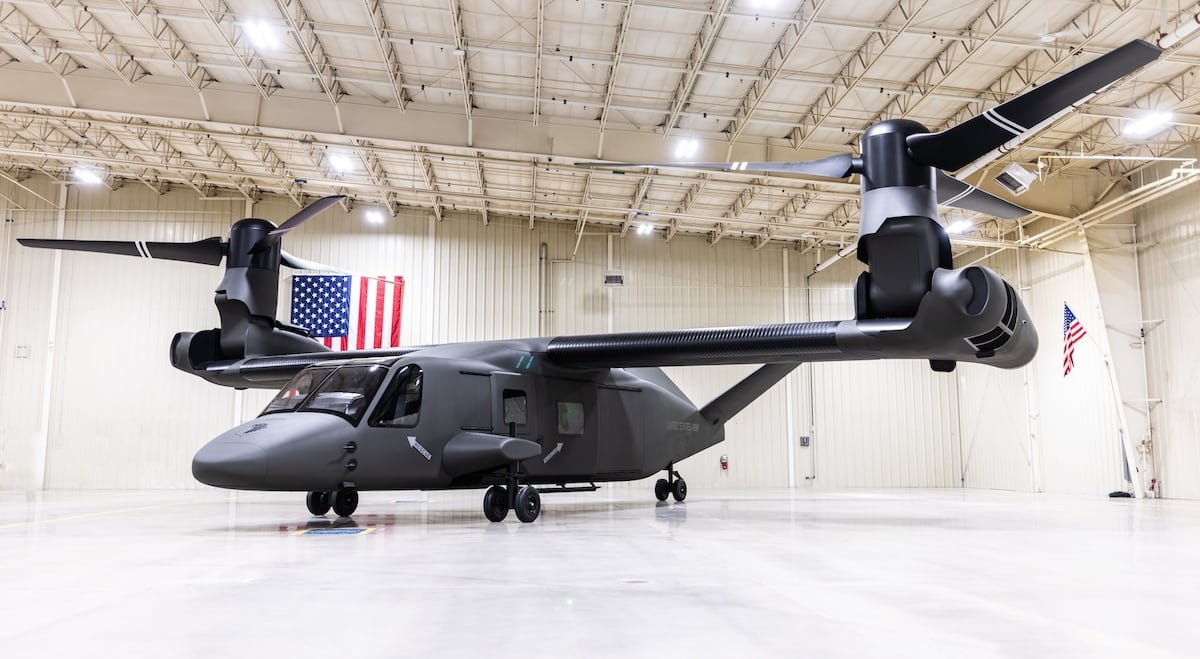
The U.S. Army’s MV-75 Cheyenne II is expected to bring increased capability to the service, not just through its boosted speed and range but also with its “digital backbone.”
Although the Cheyenne being equipped with over double the speed and range of current weapons systems will be transformative, Bell, the defense manufacturer for the aircraft, anticipates the real “revolutionary” part to be its software, Frank Lazzara, Bell’s director of MV-75 Sales & Strategy, told Military Times in an interview.
The Cheyenne program is the service’s inaugural “digital-first” weapons system with a modular open systems approach, or MOSA, that allows the Army to virtually refine its architecture and helps acquire intellectual property and data rights needed to control future upgrades and avoid vendor lock-in.
“The Army is trying to set the standard for the government to have control over their maintenance, their upgradeability, like they’ve never had before,” Lazzara said at the 2026 Association of the United States Army conference in Washington, D.C.
Bell’s open system approach differs from others, he said, because it is guided and directed by the Army, giving them more control and changing the way business is conducted throughout the lifecycle of the aircraft.
“This is the model for what the government should get when they acquire a weapon system of this level and an acquisition at this level,” Lazzara said. “That’s what gets lost out there.”
“You can hang another system on an old aircraft, and you might have a little bit more capability, but you’re never going to have the capability you have in this aircraft, plus the ability to much more easily upgrade and maintain your aircraft through its life cycle,” he continued. “That’s where the payoff really happens.”
The Cheyenne, which is designed to be a multi-mission aircraft, is the Army’s next-generation tiltrotor assault and utility aircraft, slated to replace part of the force’s UH-60 Black Hawk fleet. Its missions include long-range assault, utility, medical evacuations and humanitarian assistance.
The aircraft is designed to fly at speeds over 300 miles per hour, can carry up to 14 soldiers and support an external load of up to 10,000 pounds.
The aircraft was crafted for operations in the Indo-Pacific given its ability to cover vast distances quickly, but it can also be used in a close-in fight, special operations or as a deterrent in other theaters, Lazzara said.
While looking at a model of the aircraft on display at AUSA, Lazzara said that it is intended to make a pilot’s job easier. Someday, pilots may even be able to control Collaborative Combat Aircraft, or CCA, as it is plugged into MOSA.
There’s a heavy emphasis on controlly cost since it is a “delicate balance” because increasing capabilities and maintaining a low cost as contracted. Nothing on the aircraft was designed to be over a certain weight, allowing current equipment to be used in its construction, keeping the cost low.
The project office for the Future Long Range Assault Aircraft, or FLARRA, conducted a design evaluation of the aircraft, gathering together operators, trainers and engineers in the 101st Combat Aviation Brigade to give feedback on the design.
The 101st, based at Fort Campbell, Kentucky, was selected as the first unit to field the helicopter, with an expected arrival in 2027. The aircraft was previously set for a 2031 or 2032 delivery date, but the service announced the accelerated production timeline in January.
The evaluations, which are meant to include soldiers in the process, led to some design decisions, including seating configuration and no cockpit doors, Lazzara said. But now, Bell is at a point in the development process where it’s time to “snap the line” and only progress with what’s already been decided.
Bell is under a contract to deliver six training test aircraft and two limited-use test aircraft, but the development timing is “tough.”
“We’re in a little bit of what I would call re-evaluating what that looks like based on leadership changes in the Army, and there’s really just kind of a different feeling in the Army right now with leadership changes both at the secretary level and the chief level,” Lazzara said.
He said that there’s a series of meetings happening soon between Bell’s program team and the government to discuss the way forward, including what a feasible baseline schedule would look like without compromising capability and making sure both are aligned on funding.
The Army’s fiscal 2027 funding request allotted $2.1 billion for the Cheyenne program in the Research, Development, Test and Evaluation framework, according to budget documents, a significant boost from $350 million in fiscal 2026.
By the end of fiscal 2040, the Army anticipated up to 334 aircraft, according to a 2025 Congressional Research Service report.
“We’re obviously concerned about a [continuing resolution] because that becomes a challenge if we are under continuing resolution for a long period of time,” Lazzara said. “So a lot of what the government and our team will be talking about … is that as well. What are the contingency plans?”
“It’s a very well-supported program,” he continued. “Funding requests went through almost as exactly as we asked for it. So clearly supported on the Hill through funding. That funding for next year or ‘27, this year now fiscal, is significantly more than ‘26. So if we’re limited to ‘26 funding, you have to find ways to work through those challenges, and that’s what they’re working on now.”
The government is currently under a short-term continuing resolution, or CR, with temporary funding measures in place through Dec. 11. Another CR or the fiscal 2027 appropriations bill would have to be passed before that deadline to avoid a government shutdown.
Cristina Stassis is a reporter covering stories surrounding the defense industry, national security, military/veteran affairs and more. She previously worked as an editorial fellow for Defense News in 2024 where she assisted the newsroom in breaking news across Sightline Media Group.
Read the full article here